
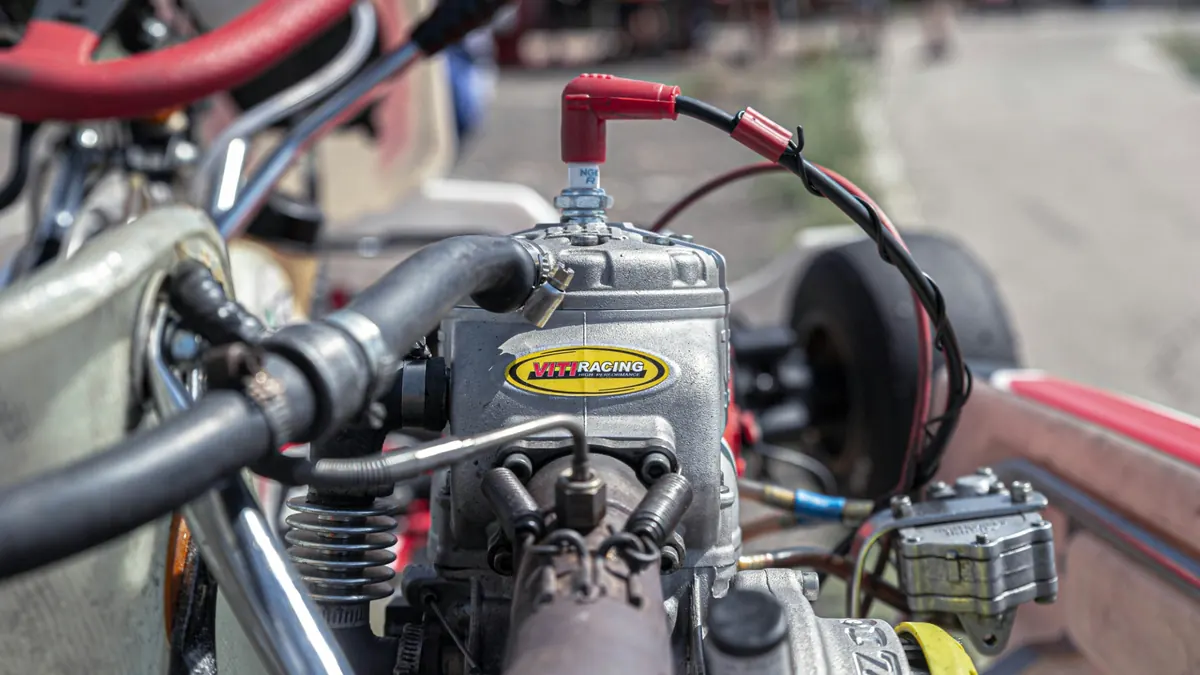
If you’re getting interested in karting, you’ll quickly encounter two common engine types: two-stroke and four-stroke engines. Both power go-karts, but they deliver different driving experiences and have different maintenance requirements.
Four-stroke engines are widely used in recreational rental karting and certain racing categories. Two-stroke engines are common in competitive karting, where acceleration, engine responsiveness and performance are major priorities.
Understanding the differences can help you choose the right karting experience, prepare for competition or make a more informed decision when buying your first racing kart.
What Is a Two-Stroke Kart Engine?
A two-stroke engine completes its operating cycle in two piston strokes, or one crankshaft revolution.
In karting, these engines are generally designed to deliver strong performance from relatively compact and lightweight packages.
Advantages of two-stroke kart engines
- Strong power-to-weight ratio: Two-stroke engines can produce considerable power relative to their size.
- Responsive acceleration: Many racing two-strokes respond quickly to throttle inputs.
- Lightweight construction: Their design can be relatively simple and compact.
- Competitive performance: They are widely used in organized kart racing categories.
Disadvantages of two-stroke kart engines
- More frequent maintenance may be required, depending on the engine.
- Engine rebuilds can become a significant operating expense.
- Fuel and lubrication requirements must be followed carefully.
- Some engines require greater technical knowledge to operate and maintain.
Two-stroke engines are particularly appealing to drivers interested in developing their skills in competitive karting.
What Is a Four-Stroke Kart Engine?
A four-stroke engine completes its operating cycle in four piston strokes, or two crankshaft revolutions.
These engines are widely used in rental karting because many models offer predictable power delivery, durability and relatively straightforward operation.
They are also used in organized racing, including popular four-stroke club-level categories.
Advantages of four-stroke kart engines
- Predictable power delivery: Many four-stroke kart engines are approachable for new drivers.
- Durability: Engines designed for recreational or endurance use can provide long service intervals.
- Lower operating costs in some categories: Certain four-stroke racing programs are designed around controlled engine specifications and manageable budgets.
- Accessibility: Four-stroke karts are common at recreational facilities.
Disadvantages of four-stroke kart engines
- Many entry-level models produce less power than performance-oriented two-stroke racing engines.
- Some engines are heavier.
- Acceleration and engine response can feel less aggressive.
- Maintenance and costs still vary significantly by engine model and racing category.
Four-stroke engines are a practical starting point for many newcomers, but they are not limited to beginner karting.
Two-Stroke vs. Four-Stroke Kart Engines: Key Differences
| Feature | Two-stroke engines | Four-stroke engines |
|---|---|---|
| Operating cycle | Two piston strokes | Four piston strokes |
| Typical applications | Performance and competitive karting | Rental karting and selected racing classes |
| Power delivery | Often more aggressive | Often smoother and more progressive |
| Maintenance | Can require frequent servicing and rebuilds | Often longer service intervals, depending on model |
| Engine weight | Often relatively lightweight | Can be heavier |
| Beginner suitability | Depends on engine and category | Often approachable, especially in rental karts |
| Racing suitability | Widely used | Also used in organized racing |
These are general characteristics rather than universal rules. Engine specifications, kart setup and class regulations can substantially change the comparison.
Which Engine Is Faster?
A two-stroke racing engine will often outperform a basic four-stroke rental engine in acceleration and overall performance.
However, engine type alone does not determine which kart is faster.
Performance also depends on:
- Engine displacement and power output
- Kart weight
- Gear ratios
- Tire grip
- Track layout
- Chassis setup
- Driver skill
A well-prepared four-stroke racing kart can be highly competitive within its intended class.
Comparing two karts only by their engine cycle can therefore be misleading.
Which Engine Is Better for Beginners?
For someone trying karting for the first time, a four-stroke rental kart is often an excellent choice.
Rental karts are generally designed to provide an accessible driving experience without requiring the driver to own equipment or maintain an engine.
Beginners can concentrate on fundamental skills such as braking, steering, racing lines and smooth throttle control.
Drivers who later decide to enter organized racing can explore either two-stroke or four-stroke categories, depending on local availability, budgets and personal objectives.
For a broader introduction, read How to Get Started in Karting: The Complete Beginner’s Guide.
Maintenance: What Should Owners Expect?
Maintenance is one of the most important differences to consider before purchasing a kart.
Two-stroke maintenance
Depending on the engine, owners may need to monitor:
- Piston and cylinder condition
- Carburetor settings
- Fuel and oil mixture requirements
- Spark plugs
- Cooling systems
- Engine operating hours and rebuild intervals
Some racing engines require specialist servicing. Always follow the manufacturer’s maintenance schedule.
Four-stroke maintenance
Typical maintenance considerations include:
- Engine oil changes
- Air filter servicing
- Valve adjustments, where applicable
- Spark plug inspection
- Fuel system care
- Chain and drivetrain maintenance
Although four-stroke engines are often associated with durability, they are not maintenance-free.
In both cases, routine inspections and proper storage help protect engine reliability.
How Much Does Each Engine Type Cost?
There is no single price difference that applies to every two-stroke and four-stroke kart engine.
A basic four-stroke engine used in rental or entry-level karting can be relatively affordable, while specialized racing engines may cost considerably more.
Two-stroke racing engines can also vary widely in purchase price, maintenance requirements and rebuild expenses.
Before choosing an engine, consider the total cost of ownership, including:
- Initial engine purchase
- Replacement parts
- Routine servicing
- Engine rebuilds
- Fuel and lubricants
- Specialist labour
- Racing class requirements
The cheapest engine to purchase is not necessarily the cheapest to race over an entire season.
Which Engine Should You Choose for Racing?
The best engine is usually the one that fits an established racing category available at the tracks and clubs where you plan to compete.
Before purchasing, confirm:
- Which engine packages are permitted in your intended category.
- Whether the category is appropriate for your age and experience.
- What maintenance support and replacement parts are available locally.
- How much a typical racing season may cost.
- Whether you can try or observe the category before committing.
Buying a powerful engine that does not qualify for your local racing program can become an expensive mistake.
For more information about the competitive pathway, see How to Start Kart Racing in Québec: Licences, Classes, Clubs and Your First Race.
Frequently Asked Questions
Are all rental karts four-stroke?
No. Many rental facilities use four-stroke engines, but electric rental karts and other configurations are also available.
Are all racing karts two-stroke?
No. Both two-stroke and four-stroke engines are used in organized kart racing. The available categories depend on the governing organization and local championship.
Do two-stroke engines always require more maintenance?
Not always. Maintenance depends on the specific engine, its operating conditions and manufacturer requirements. However, high-performance two-stroke racing engines often require more frequent internal servicing than many recreational four-stroke engines.
Can you learn racing skills in a four-stroke kart?
Absolutely. Braking technique, racing lines, consistency, overtaking and racecraft can all be developed in four-stroke karts.
Should I buy an engine before choosing a racing category?
Generally, no. Confirm the applicable class regulations and local racing opportunities before purchasing an engine or complete kart.
Final Thoughts
Two-stroke and four-stroke kart engines each have an important place in karting.
Two-stroke engines are especially prominent in performance-oriented racing, while four-stroke engines are widely used in recreational karting and certain competitive categories.
For beginners, the most important decision is not necessarily which engine produces the most power. It’s choosing a kart and racing environment that match your experience, goals and budget.
To explore the wider range of kart designs and powertrains, read Types of Go-Karts Explained: Rental, 4-Stroke, 2-Stroke & Electric Karts.
DNA Karting helps newcomers and experienced enthusiasts understand karting equipment, driving techniques and the different paths into the sport.
