
If you’ve ever watched a kart race after trying rental karting, you may have wondered why the machines look and sound so different.
Some karts are built to survive thousands of recreational sessions with minimal downtime. Others are lightweight racing machines designed for precise handling, rapid acceleration, and competition. Some run on gasoline, others use electric motors, and the engines can have very different characteristics.
Understanding these differences is one of the best ways to make sense of karting.
Not all go-karts are designed for the same purpose. A rental kart is not simply a slower racing kart, and a two-stroke racing engine is not automatically the right choice for a beginner.
In this guide, we’ll explore the major types of go-karts, explain how four-stroke and two-stroke engines work, compare gasoline and electric power, and help you identify the most suitable kart for your goals.
We’ll also look at the karting categories you may encounter in Québec and what to consider before purchasing your first competition kart.
1. What Are the Main Types of Go-Karts?
Go-karts can be grouped in several ways: by intended use, engine technology, driver age, or competition category.
For a beginner, the most useful distinction is between rental karts and competition karts.
Rental go-karts
Rental karts are operated by commercial karting facilities. They’re designed to accommodate many drivers, withstand frequent use, and be relatively straightforward for staff to maintain.
They typically feature:
- Robust frames and protective bodywork.
- Adjustable seating or pedals on some models.
- Engines or electric motors selected for reliable operation.
- Performance settings suited to the venue and driver group.
- Safety systems and operating procedures controlled by the facility.
Rental karts may be powered by gasoline or electricity. Some facilities also offer higher-performance rental fleets for experienced drivers.
Competition go-karts
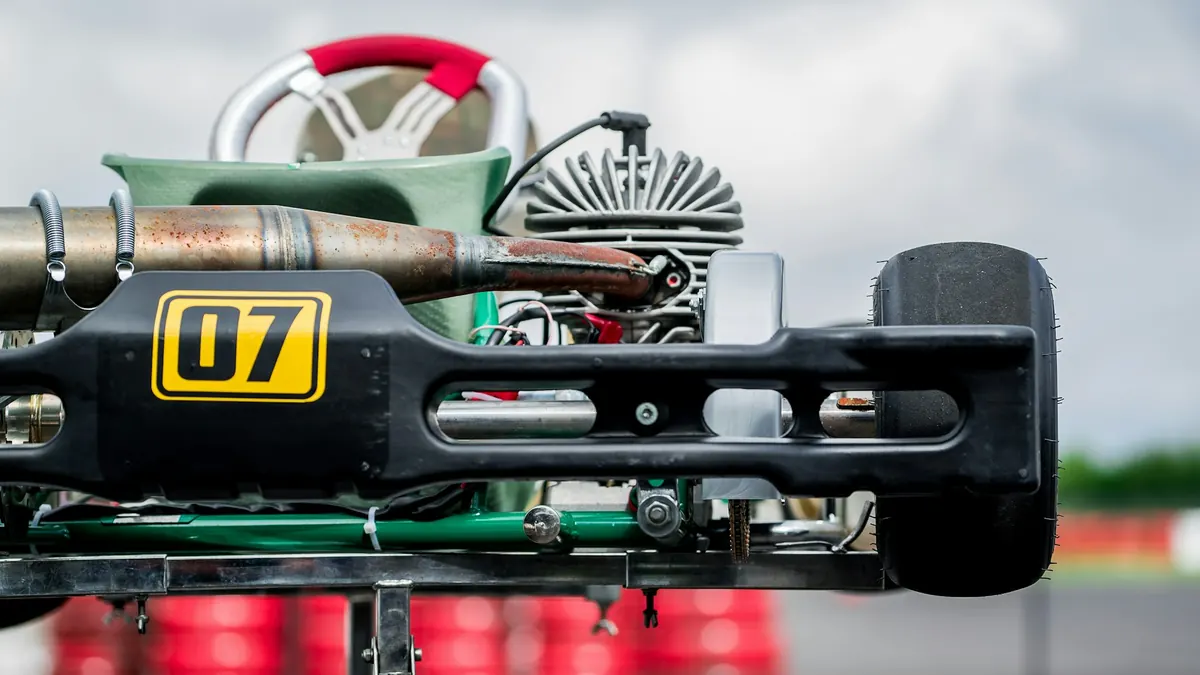
Competition karts are designed for racing or performance-oriented practice.
Compared with typical rental machines, they generally have:
- Lighter, more specialized chassis.
- More responsive steering and braking.
- Competition tires selected for a particular class.
- Engines governed by technical regulations.
- More frequent inspection and maintenance requirements.
- Fewer protective structures around the wheels.
Competition karts are usually owned by individual drivers, families, teams, or karting organizations.
They are not intended for unrestricted use on public roads.
Other categories
You may also encounter recreational off-road go-karts, concession karts, historic racing karts, and specialized machines.
Those vehicles can be interesting, but this guide focuses primarily on the types used for circuit karting.
If you’re still exploring the sport, start with our beginner’s guide to karting to understand the different ways to get involved.
2. Rental Karts vs. Racing Karts: What’s the Difference?
The most noticeable differences are weight, handling, protection, and intended use.
A rental kart is designed to perform consistently despite being driven by many different people. It may have heavier bodywork, more protective bumpers, and settings that make it easier to operate.
A competition kart prioritizes handling response and performance within the regulations of its racing class.
| Feature | Typical rental kart | Typical competition kart |
|---|---|---|
| Main purpose | Recreational driving | Racing and performance practice |
| Ownership | Track operator | Driver, family, or team |
| Chassis | Durable, often heavier | Lightweight, class-specific |
| Bodywork | Extensive protection | Competition bodywork |
| Engine | Gasoline or electric | Class-regulated gasoline or electric |
| Maintenance | Handled by operator | Handled by owner or team |
| Setup adjustments | Usually limited for driver | Often adjustable |
| Driving experience | Accessible and controlled | More responsive and demanding |
| Initial investment | Session fee | Kart, equipment, tools, and operating costs |
These are general tendencies, not absolute rules. Some rental karts are extremely quick, and some entry-level racing classes deliberately limit performance.
Why racing karts feel different
Competition karts often react more directly to steering, braking, and weight transfer.
Small driving errors can become more noticeable. A poor corner entry may affect the kart’s balance and compromise acceleration on the following straight.
This makes competition karting a valuable environment for developing precision and consistency.
However, the increased responsiveness also demands proper instruction and an appropriate level of experience.
For drivers who want to experience karting without purchasing equipment, our rental karting guide explains how recreational karting works and what to expect at a track.
3. What Is a Four-Stroke Go-Kart Engine?
A four-stroke engine completes its combustion cycle over four piston strokes:
- Intake.
- Compression.
- Power.
- Exhaust.
These strokes take place over two crankshaft revolutions.
Four-stroke engines are common in many rental fleets and in several entry-level competition categories.
Characteristics of four-stroke kart engines
Depending on the engine and class, advantages may include:
- Relatively predictable power delivery.
- Good durability when maintained correctly.
- Established parts and service support.
- Lower operating costs than some high-performance alternatives.
- Technical regulations that can help control competition expenses.
However, four-stroke engines are not maintenance-free. They still require appropriate oil changes, inspections, and servicing.
The Briggs & Stratton LO206
One of the best-known four-stroke competition engines in North America is the Briggs & Stratton LO206.
The LO206 is a sealed, approximately 206 cc single-cylinder four-stroke engine used in kart racing classes governed by specific technical regulations.
Its popularity comes partly from its relatively straightforward design and rules intended to limit certain engine modifications.
Rather than chasing expensive engine development, drivers can focus on setup, racecraft, and consistent driving.
That does not mean every LO206 race is inexpensive or that all competitors have identical operating costs. Tires, chassis preparation, travel, race entries, and maintenance still matter.
Who should consider a four-stroke competition kart?
A four-stroke class may be attractive if you:
- Want to move from rental karting into club racing.
- Prefer a relatively manageable maintenance program.
- Want to learn chassis setup and racing technique.
- Have access to an active local class.
- Want to control costs before considering higher-performance machinery.
The most important factor is local participation. A technically appealing kart isn’t a useful purchase if no nearby club runs its class.
4. What Is a Two-Stroke Go-Kart Engine?
A two-stroke engine completes its combustion cycle in two piston strokes, or one crankshaft revolution.
Its design differs from that of a conventional four-stroke engine, including how fresh charge enters the cylinder and exhaust gases leave it.
Two-stroke engines are widely associated with performance-oriented kart racing.
Why are two-stroke karts popular in competition?
Many two-stroke kart engines offer:
- High power relative to engine size and weight.
- Rapid engine response.
- Strong acceleration in suitable racing applications.
- A distinctive high-revving sound.
- Established racing categories and international competition pathways.
However, performance depends on the engine, kart class, gearing, track, and regulations. Not every two-stroke kart is faster than every four-stroke kart in every situation.
Maintenance considerations
High-performance two-stroke engines can require more specialized attention.
Depending on the engine and use, maintenance may involve:
- Piston and ring inspections or replacement.
- Carburetor or fuel-system adjustments.
- Cooling-system checks.
- Exhaust-system inspection.
- Periodic engine rebuilds.
- Careful compliance with technical regulations.
Many two-stroke kart engines use fuel mixed with a specified lubricant, although exact requirements vary.
Always follow the engine manufacturer’s instructions and the regulations of your racing class.
Common two-stroke racing families
Rotax MAX
Rotax MAX engines are used in a range of age- and performance-specific karting categories.
They are known for organized technical regulations and a structured competition ecosystem.
IAME engines
IAME produces engines used in several karting categories, including X30-based racing.
Different IAME products have different specifications, eligibility rules, and maintenance needs.
Shifter karts
Shifter karts typically use a gearbox and a clutch system that allows the driver to select gears.
They add another layer of complexity to driving and maintenance. They are generally not the first competition kart a newcomer should purchase.
5. Four-Stroke vs. Two-Stroke Karts: Full Comparison
| Characteristic | Four-stroke kart | Two-stroke kart |
|---|---|---|
| Engine cycle | Four piston strokes | Two piston strokes |
| Typical racing examples | Briggs LO206 | Rotax MAX, IAME X30 |
| Power delivery | Often progressive | Often more aggressive at higher RPM |
| Mechanical complexity | Depends on engine | Depends on engine |
| Maintenance | Often more manageable in entry-level classes | Often more specialized in high-performance classes |
| Engine sound | Generally deeper | Generally sharper and higher-pitched |
| Fuel system | Depends on engine | Often requires specified fuel/oil mixture |
| Common beginner appeal | Club racing and cost control | Performance progression |
| Best choice | Depends on local class and budget | Depends on experience and racing goals |
It’s important not to overgeneralize.
A well-maintained four-stroke kart can be more reliable than a poorly maintained two-stroke kart, and a lower-output two-stroke class may be appropriate for younger drivers under a properly structured racing program.
The specific racing class matters more than the engine label alone.
6. How Fast Can Different Go-Karts Go?
Speed is one of the first questions newcomers ask.
Unfortunately, there isn’t one accurate maximum speed for each type of kart.
Top speed depends on:
- Engine or motor output.
- Kart and driver weight.
- Gear ratios.
- Tire size.
- Track length and layout.
- Aerodynamic resistance.
- Electronic performance limits.
- Class regulations.
As broad illustrations, recreational rental karts may operate at speeds of several tens of kilometres per hour, while some high-performance competition karts can exceed 100 km/h on suitable circuits.
Those examples should not be treated as guarantees for a particular kart or venue.
Why lap time matters more than top speed
A kart that reaches a high maximum speed isn’t necessarily quicker around a circuit.
Cornering, braking, traction, gearing, and driver technique all affect lap time.
On a technical track, a kart with less peak power may be very competitive if it maintains speed through corners.
For beginners, learning to drive smoothly is more valuable than choosing the fastest available machine.
7. Electric Go-Karts: How Do They Compare?
Electric karting has become an important part of recreational karting, especially at indoor facilities.
Instead of an internal combustion engine, an electric kart uses a battery-powered motor and an electronic control system.
Advantages of electric karts
Immediate torque response
Electric motors can deliver torque quickly, creating strong acceleration from low speeds.
No tailpipe emissions
Electric karts produce no exhaust emissions at the vehicle, which is particularly useful in indoor environments.
Reduced engine noise
They are generally quieter than gasoline-powered karts, although tire and mechanical noise remain.
Adjustable performance
Many commercial electric fleets allow operators to configure power or speed settings for different groups.
Different maintenance needs
Electric motors avoid certain combustion-engine maintenance tasks, but batteries, electrical systems, brakes, tires, and chassis components still require attention.
Limitations of electric karts
Electric karting also involves tradeoffs.
Battery charging, battery condition, thermal management, and fleet management can affect operations.
A heavier battery system can influence vehicle weight and handling.
The environmental impact also depends on electricity generation, battery production, equipment life, and other factors—not just the absence of tailpipe emissions.
Are electric karts faster than gasoline karts?
Neither technology is automatically faster.
A powerful electric rental kart may accelerate more strongly than a conventional gasoline rental kart, while a purpose-built gasoline racing kart may offer much higher overall circuit performance.
Compare specific models and track conditions rather than relying on the power source alone.
8. Understanding the Main Parts of a Racing Kart
Before purchasing a kart, it helps to understand its major components.
Chassis
The chassis is the kart’s structural frame.
Its design and flexibility influence how the kart behaves in corners.
Most conventional sprint racing karts do not use the same suspension layout found on passenger cars. Chassis flex and tire behaviour play important roles in handling.
Engine
The engine provides propulsion and must comply with the regulations of the selected racing class.
Rear axle
The rear axle transfers power to the rear wheels.
Its stiffness and configuration can influence handling, although setup choices should follow the chassis manufacturer’s guidance.
Braking system
Competition karts use braking systems appropriate to their class.
Some configurations primarily brake the rear axle, while others use additional front braking arrangements.
Tires
Tires are critical to grip, braking, and cornering.
Many racing categories specify permitted tire compounds and brands.
Steering system
Kart steering is mechanically direct, making driver input and alignment important.
Seat
The seat positions the driver and contributes to the overall chassis setup.
Seat fit and placement matter for comfort, control, and handling.
Bodywork
Competition bodywork is designed according to class rules and can include front fairings, sidepods, and rear protection.
9. What Karting Categories Can You Find in Québec?
Karting categories vary by club, event, age group, and season.
In Québec and elsewhere in Canada, you may encounter classes based around:
- Briggs & Stratton LO206 four-stroke engines.
- Rotax MAX two-stroke engines.
- IAME-based two-stroke competition.
- Age-specific cadet, junior, and senior divisions.
- Masters or other eligibility-based divisions.
- Rental karting leagues and championships.
Not every circuit offers every category.
Rules may differ between championships, including engine specifications, tires, minimum weight, age eligibility, and safety equipment.
Before purchasing a kart, consult the current regulations and entry lists of the club or championship you intend to join.
Why local support matters
Imagine buying a kart that looks attractive online, only to discover that your nearest track doesn’t host races for its engine class.
You might need to travel farther, replace components, or purchase a different kart.
A better approach is to visit local events first, observe the categories, and ask experienced participants which classes are active and beginner-friendly.
10. Which Type of Go-Kart Is Best for Beginners?
The best choice depends on what you want to accomplish.
If you want to try karting for fun
Choose a rental kart.
You’ll get a structured introduction without needing mechanical knowledge or an equipment investment.
If you want to improve your driving regularly
Continue with rental karting and consider a rental league.
A league lets you practice consistency, passing, and race strategy.
If you want to enter club competition
Investigate a four-stroke class such as LO206, provided it’s active locally and appropriate for your age and goals.
It can offer a practical route into competition.
If you want a performance-focused racing pathway
Explore the two-stroke categories offered by your local clubs.
A properly supported junior or senior class may be appropriate depending on your experience, eligibility, and budget.
If you want indoor karting throughout the year
An electric rental kart may be convenient, particularly in the Montréal region during winter.
The right choice is not necessarily the fastest or most expensive kart. It’s the one that gives you appropriate driving opportunities at a sustainable cost.
If your goal is organized racing, our guide to starting kart racing in Québec explains how to approach clubs, racing classes, licences, and your first event.
11. How Much Does Each Type of Kart Cost?
The purchase price and the total cost of ownership are very different.
| Kart type | Typical way to pay | Financial considerations |
|---|---|---|
| Rental gasoline kart | Per session or package | No personal mechanical maintenance |
| Rental electric kart | Per session or package | No personal charging or battery maintenance |
| Rental league kart | League registration | Competition without owning equipment |
| Used four-stroke racing kart | Purchase | Tools, safety gear, maintenance, track fees |
| New four-stroke racing kart | Purchase | Higher initial cost plus recurring expenses |
| Two-stroke competition kart | Purchase | Potentially higher engine and operating costs |
| Shifter kart | Purchase | Greater complexity and potentially substantial operating costs |
For a detailed budget—including rental sessions, equipment, track fees, and first-year racing expenses—read our companion article, How Much Does Karting Cost in Québec?
The key is to budget for the complete experience rather than focusing on the advertised kart price.
Kart prices are only one part of the overall budget. See our complete breakdown of karting costs in Québec for equipment, maintenance, track fees, and racing expenses.
12. Should You Buy a Used Racing Kart?
Buying used can be an excellent way to enter competition, but only if you understand what you’re purchasing.
Questions to ask the seller
- What is the chassis manufacturer, model, and approximate age?
- Which engine is installed?
- Is the engine legal for the intended racing class?
- When was the engine last serviced?
- Has the chassis been damaged or repaired?
- What tires, wheels, and spare parts are included?
- Are maintenance records available?
- Can a knowledgeable mechanic inspect the kart?
- Is local parts support available?
A kart that has been properly maintained and supported by a local shop may be a better purchase than a cheaper machine with an uncertain history.
Avoid buying solely on appearance
Fresh bodywork and attractive graphics don’t guarantee a straight chassis or a healthy engine.
Mechanical condition, regulatory compliance, and local support are much more important.
13. Common Mistakes When Choosing a First Kart
Buying the fastest kart available
High performance can be exciting, but it also increases the demands placed on the driver.
Start with equipment suited to your experience.
Ignoring local racing regulations
A kart must be eligible for the category you want to enter.
Check the rules before spending money.
Underestimating maintenance
Even entry-level competition requires regular inspection and servicing.
Forgetting the safety equipment budget
A kart purchase is incomplete without the appropriate helmet, clothing, and other mandatory protection.
Choosing an inactive class
A class with few local participants may provide limited racing opportunities.
Skipping rental karting
Rental sessions can help you develop basic technique and determine whether you’re ready for a larger commitment.
Frequently Asked Questions
What is the difference between a go-kart and a racing kart?
A go-kart is a broad term for a small motorized kart. A racing kart is specifically designed for organized competition or performance-oriented practice.
Are four-stroke karts slower than two-stroke karts?
Many high-performance two-stroke classes produce more power than entry-level four-stroke classes, but actual speed depends on the engine, kart, track, and regulations.
Is the Briggs LO206 a good beginner engine?
It can be an excellent option for club racing when an active local class, suitable age division, and technical support are available.
Do electric go-karts have gears?
Many electric rental karts use a simple drivetrain without a driver-operated multi-speed gearbox. Designs vary by manufacturer.
Do racing karts have suspension?
Most conventional sprint racing karts do not have car-style suspension. Chassis flexibility and tire behaviour are important to how they handle.
Can I drive a competition kart on public roads in Québec?
Competition karts are intended for approved circuits and controlled environments, not ordinary public-road use.
What is a shifter kart?
A shifter kart is a competition kart equipped with a gearbox that allows the driver to change gears. It generally requires additional driving skill and maintenance knowledge.
Should I buy a two-stroke or four-stroke kart first?
Choose based on your local racing classes, age eligibility, budget, experience, and available technical support—not simply the engine cycle.
Conclusion: Choose the Kart That Matches Your Goals
The world of karting includes everything from accessible rental machines to highly specialized competition karts.
Four-stroke engines are common in recreational and entry-level racing environments. Two-stroke engines power many performance-oriented competition categories. Electric karts offer a different driving experience and are particularly well suited to certain indoor facilities.
But the most important question isn’t which technology is best overall.
It’s which type of kart is right for you.
If you’re just starting out, rental karting is usually the smartest first step. If you want to race, learn about your local clubs, regulations, and costs before buying equipment.
At DNA Karting, we believe understanding the machinery helps drivers make better decisions and enjoy the sport more.
Continue learning: Read How to Get Started in Karting: The Complete Beginner’s Guide for your first steps, and How Much Does Karting Cost in Québec? to plan your budget.
