



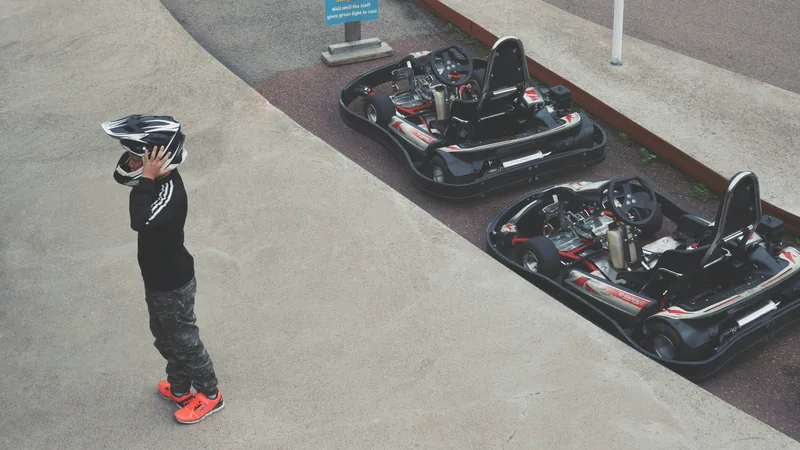
Karting can be an exciting introduction to motorsport for children. It offers opportunities to develop concentration, coordination and confidence while learning to control a motorized vehicle. However, parents should understand the risks and safety requirements before allowing a child to drive.
A go-kart is not a toy. Even during recreational sessions, drivers may encounter sudden braking, changes in direction, contact with barriers or collisions with other karts. Protective equipment, appropriate vehicles, clear instructions and attentive supervision all play important roles in reducing risk.
For parents, the most important question is not simply whether a child meets the minimum age requirement. It is whether the child can operate the kart correctly, understand instructions, remain comfortable and participate in an appropriately supervised environment.
This DNA Karting guide explains the essential safety considerations, from helmets and protective clothing to physical readiness, supervision and parental decision-making.
1. Understanding the Main Safety Risks
Karting involves inherent risks that cannot be completely eliminated. The nature and level of those risks depend on the kart, circuit, activity format, operating procedures and driver’s experience.
Collisions and contact
Children may misjudge distances, brake too late or react unexpectedly when another driver changes direction.
Contact with another kart or a protective barrier can produce sudden forces, even during relatively low-speed recreational activities.
Loss of control
Inexperienced drivers may make abrupt steering movements, approach corners too quickly or struggle to coordinate braking and steering.
These situations can result in spins or departures from the intended driving path.
Equipment problems
A loose helmet, unsuitable footwear or protective equipment that restricts movement may interfere with the child’s ability to drive or respond appropriately.
Equipment must fit the individual child rather than simply correspond to a general age range.
Fatigue and reduced attention
Driving requires sustained concentration. A child who becomes tired, distracted or overwhelmed may have difficulty responding to instructions or changing track conditions.
Hazards outside the circuit
Pit lanes, paddocks and preparation areas may contain moving vehicles, hot mechanical components, tools and restricted working areas.
Parents must consider safety throughout the facility, not only while the child is driving.
These risks make preparation important. They do not mean that every child faces the same level of risk or that a particular activity is automatically unsuitable.
2. Age, Height and Eligibility Requirements
Parents frequently ask about the minimum age for karting.
There is no universal minimum that applies to every recreational and competitive karting activity.
Requirements vary according to the operator, kart design, activity format and applicable regulations.
Recreational karting
Rental facilities may establish minimum ages, minimum heights or both.
Some also evaluate whether a child can reach the controls, remain properly seated and understand instructions.
Meeting an age requirement does not automatically establish that a child is physically ready.
Competitive karting
Junior racing classes are governed by sporting and technical requirements that can differ from recreational karting rules.
Eligibility for a rental session does not automatically establish eligibility for competition.
Parents interested in the broader progression into organized racing can read our guide to starting kart racing in Québec. The present article focuses specifically on safety rather than the steps required to enter competition.
Why height alone is insufficient
A child must be able to:
- Reach and operate the accelerator and brake.
- Turn the steering wheel without losing proper seating position.
- Remain securely positioned in the kart.
- Understand basic operating instructions.
- Respond to staff signals.
- Communicate discomfort or uncertainty.
Parents should never use improvised cushions, unauthorized pedal extensions or other modifications to make an unsuitable kart fit.
Any adjustments must follow the operator’s approved procedures.
3. Ensuring the Kart Fits the Child
Children of the same age may differ significantly in height, strength, coordination and confidence.
The actual vehicle must therefore be assessed before driving.
Seating position
The child should sit in the intended position without excessive movement or the need to lean forward to reach the controls.
Approved seat inserts or adjustments may be available, but their suitability should be confirmed by the operator.
Pedal reach
The child must be able to operate the brake and accelerator effectively.
Simply touching the pedals is not sufficient.
If the child must stretch excessively or shift position to brake, the kart may be unsuitable.
Steering control
The child should be able to turn the steering wheel comfortably while remaining properly seated.
Excessive steering effort or an inability to maintain control is a reason to reconsider participation.
Speed and vehicle category
Some facilities offer karts specifically designed for younger drivers or systems that allow speed to be managed.
Parents should ask how these arrangements work and whether the session is appropriate for a beginner.
Reduced speed can be one useful precaution, but it does not replace suitable equipment or supervision.
If the kart does not fit, parents should request another vehicle or postpone participation rather than improvising a solution.
4. Choosing and Fitting a Children’s Karting Helmet
A helmet is an essential piece of protective equipment, but its effectiveness depends on suitability, fit, condition and correct use.
Confirm the required helmet standard
Helmet requirements differ between recreational rental karting and regulated competition.
Some junior racing categories require helmets meeting recognized standards specifically applicable to younger drivers.
Parents should verify the rules for the activity rather than assuming that a bicycle, motorcycle or general-purpose helmet is acceptable.
Check the fit
A correctly fitted helmet should remain stable when the child moves their head.
It should not slide excessively, obstruct vision or cause significant pressure.
Children should be encouraged to report discomfort rather than tolerate an unsuitable helmet.
Secure the fastening system
The chin strap or other approved retention system must be fastened according to the manufacturer’s instructions.
A helmet that is not secured may fail to remain in its intended position.
Inspect the condition
Visible cracks, damaged straps, compromised fasteners or other deterioration are reasons to reject a helmet.
A helmet that has sustained an impact may require replacement or assessment according to the manufacturer’s guidance, even if damage is not visible.
Rental helmets
When helmets are provided by the facility, parents should confirm that an appropriate size is available and that the operator checks equipment condition.
A hygiene liner or balaclava does not compensate for a poorly fitted helmet.
5. Other Protective Equipment
The equipment required depends on the activity and applicable regulations.
Parents should distinguish recreational rental requirements from the more specific equipment rules used in organized competition.
Body and chest protection
Certain junior competition categories require body protection meeting specified standards.
A protector must fit correctly and remain properly positioned.
Parents should confirm whether protection is mandatory, provided or permitted for the activity.
Protective clothing
Competitive karting generally requires specialized protective clothing that meets applicable regulations.
Recreational facilities may provide suits or establish clothing requirements.
Clothing should not restrict movement or create loose material that could interfere with driving.
Gloves
Gloves can provide hand coverage and support grip.
They should fit well enough for the child to hold the steering wheel and operate controls without excess material interfering with movement.
Footwear
Footwear should provide secure, controlled pedal operation.
Closed-toe shoes are commonly required in rental karting, while competition may require specialized karting boots.
Sandals, loose shoes and footwear that interferes with pedal use should be avoided.
Hair and accessories
Long hair should be secured according to the operator’s requirements.
Loose jewellery, scarves and accessories that might interfere with helmet fit or become caught in equipment should be removed or secured as instructed.
Neck supports and optional accessories
Parents may encounter neck collars or other protective accessories.
Their use and suitability depend on the activity, applicable regulations and equipment design.
They should not be assumed universally mandatory, beneficial or permitted.
6. Why Equipment Fit Matters
Protective equipment should be selected for function rather than appearance.
A helmet can meet an accepted standard yet fit a particular child poorly.
A racing suit can be compliant but too large.
A body protector can be correctly labelled but incorrectly positioned.
Before participation, parents should confirm that the equipment is accepted for the activity, fits the child, is in good condition and allows normal movement.
Fasteners should be checked, and the child should be asked whether anything feels uncomfortable.
Equipment should be reassessed as the child grows.
Buying oversized protective equipment in anticipation of future growth may compromise its intended function.
7. Supervision and Safety Briefings
Appropriate supervision is a central consideration when children participate in karting.
Parents should understand how the activity is monitored, how instructions are communicated and how staff respond to incidents.
A briefing the child understands
The briefing should explain:
- The accelerator and brake.
- Basic driving rules.
- Track signals and staff instructions.
- What to do if the kart stops.
- How to request assistance.
- Procedures for returning to the pit area.
The explanations should be appropriate for the child’s age and experience.
A child who nods during the briefing may not necessarily understand every instruction.
Parents can help by asking the child to explain the essential procedures in their own words.
Active supervision
The facility should have an appropriate way to monitor driving activity.
Depending on the operator, this may involve marshals, cameras, electronic speed controls or other systems.
Electronic controls alone should not be assumed to provide complete supervision.
Clear incident procedures
Parents should ask what happens if a child spins, becomes immobilized or experiences a problem.
At many facilities, remaining seated until staff intervene is the normal instruction. However, an immediate emergency or specific local procedure may require a different response.
The child must follow the instructions provided for that facility.
Emergency arrangements
An operator should be able to explain how incidents are handled, how first aid is provided and how emergency assistance is contacted when necessary.
These procedures reduce uncertainty but cannot guarantee that injuries will never occur.
For broader guidance on evaluating a facility’s safety arrangements, see DNA Karting’s guide to evaluating a karting track.
8. Assessing a Child’s Readiness
Age and height are only part of the decision.
A child’s readiness also involves physical control, comprehension, attention and emotional comfort.
Physical readiness
Can the child sit correctly, reach the controls and operate them effectively while wearing the required equipment?
If not, participation should be postponed or a more suitable activity selected.
Understanding
Can the child explain what the brake does, how to respond to staff signals and what to do if the kart stops?
Advanced technical knowledge is unnecessary, but essential instructions must be understood.
Attention and impulse control
Can the child remain focused and follow rules even when excited?
A child who repeatedly ignores instructions may not yet be ready for independent kart driving.
Emotional readiness
Does the child genuinely want to participate?
Some children become anxious when they hear engines or see the track.
Fear and hesitation should be respected rather than treated as obstacles to overcome through pressure.
Willingness to ask for help
Children should feel comfortable reporting discomfort, confusion or fear.
Parents can reinforce that asking for assistance is responsible.
Readiness may also vary from one day to another. A child who drove comfortably previously may be tired, unwell or overwhelmed during a later visit.
9. Parent Responsibilities Before Driving
The operator supervises the activity, but parents retain important responsibilities.
Provide accurate eligibility information
Age, height and experience should be reported honestly.
Parents should never exaggerate a child’s ability to obtain access to a faster or more demanding activity.
Discuss relevant support needs
A medical condition, disability, injury or other individual need may require accommodations or additional precautions.
Parents should discuss practical requirements with the operator and seek individualized medical advice when appropriate.
Prepare the child without pressure
Explain that karting involves rules, concentration and respect for other participants.
Avoid presenting driving as a test of bravery.
Verify equipment and supervision
Confirm what equipment the facility supplies, what must be brought and whether parents must remain on site.
A karting booking should not automatically be treated as a childcare arrangement.
Explain shared-track behaviour
Children should understand that karts are not bumper cars and that other drivers may also be inexperienced.
Deliberate contact, ignoring instructions and unsafe behaviour are unacceptable.
For a more detailed explanation, read our rental karting rules and etiquette guide.
10. What Parents Should Watch During a Session
Parents should remain in authorized viewing areas and avoid interfering with staff supervision.
However, observation can help identify concerns.
Difficulty controlling the kart
Repeated uncontrolled movements, significant braking difficulties or multiple incidents may indicate that the child needs more instruction or a different activity.
Distress or discomfort
A child who appears frightened, overwhelmed or physically uncomfortable may need to stop.
Parents should communicate concerns through the facility’s established procedure.
Equipment problems
If a helmet becomes displaced or protective equipment comes loose, notify staff.
Never enter an active circuit to adjust equipment yourself.
Fatigue
Children may become tired before the scheduled session ends.
Completing the entire session should never take priority over the child’s ability to continue safely.
Staff instructions
Parents should not encourage children to ignore marshals, drive faster than permitted or continue after staff have stopped their participation.
11. Safety in Pit Lanes and Paddocks
Safety remains important when the child is not driving.
Pit lanes and paddocks may contain moving vehicles, tools, fuel, hot mechanical components and restricted working areas.
Children should remain in authorized locations and follow pedestrian-access rules.
They should not touch unfamiliar mechanical equipment or enter active workspaces without permission.
Parents should also supervise younger siblings and ensure that pedestrian routes and emergency access remain clear.
Mechanical concerns involving rental karts must be reported to the operator rather than addressed through unauthorized adjustments.
For families involved in club-organized karting, it is also useful to understand how responsibilities may be divided between a club, a circuit operator and participating families. Our guide to how karting clubs work explains those organizational distinctions.
12. When to Postpone or Stop Participation
Sometimes the responsible decision is not to drive.
Participation should be reconsidered when the child cannot operate the controls comfortably, required equipment is unsuitable, essential instructions are not understood or the child does not want to participate.
Other reasons include illness, unusual fatigue, unresolved mechanical concerns or inadequate clarity about supervision and emergency procedures.
If staff determine that a child should not continue, that decision must be respected.
Stopping is not a failure. It is a normal part of making informed safety decisions.
13. Common Mistakes Parents Should Avoid
Assuming minimum age means readiness
An age requirement is not a complete assessment of physical, cognitive or emotional preparedness.
Accepting unsuitable equipment
Protective gear that is damaged, too large or uncomfortable should be corrected or replaced before driving.
Assuming every junior kart is identical
Different vehicles may have different seating positions, controls and performance characteristics.
Assess the actual kart.
Pressuring a hesitant child
A child who does not want to drive should not be forced to participate.
Treating supervision as someone else’s entire responsibility
Operators supervise their activities, but parents remain responsible for preparation, honest information and appropriate support.
Confusing rental and competition requirements
Equipment rules and operating procedures may differ substantially.
Verify the requirements that apply to the particular activity.
Believing that precautions eliminate all risk
Safety measures can reduce certain hazards but cannot make motorsport risk-free.
14. A Five-Part Parental Safety Framework
Parents can organize their decision around five questions.
1. Eligibility
Does the child meet the operator’s participation requirements?
2. Vehicle fit
Can the child sit correctly and operate the controls comfortably?
3. Protective equipment
Is the required equipment appropriate, correctly fitted and in good condition?
4. Supervision
Are instructions understandable, activities monitored and incident procedures clear?
5. Individual readiness
Does the child understand the rules, remain attentive and genuinely want to participate?
If an important concern remains unresolved, address it before allowing the child to drive.
This framework supports decision-making but does not guarantee an injury-free experience.
15. Frequently Asked Questions
Is karting safe for children?
Karting involves inherent risks. Suitable equipment, appropriate vehicles, supervision and clear operating procedures can reduce certain risks but cannot eliminate them.
What is the minimum age for children’s karting?
There is no universal minimum. Requirements depend on the operator, vehicle, activity and applicable regulations.
Does a child need a special helmet?
The helmet must be accepted for the activity and fit correctly. Certain competitive categories require helmets meeting specific standards.
Do children need chest or body protection?
Requirements vary. Some junior competition categories mandate specific body protection. Parents should confirm the rules before participation.
Should parents remain at the facility?
Follow the operator’s accompaniment requirements and understand who supervises children before, during and after driving.
What if a child becomes frightened?
Respect the child’s discomfort and notify staff through the appropriate procedure. Do not pressure the child to continue.
Can a child drive if they meet the height requirement but cannot brake comfortably?
No. The child must be able to operate the controls effectively.
Should parents buy equipment before the first session?
Not necessarily. Some rental facilities supply required equipment. Confirm what is provided and whether suitable sizes are available.
Conclusion: Safety Begins With Informed Decisions
Children’s karting safety depends on more than age limits and helmets.
The kart must fit the child. Protective equipment must be appropriate and correctly worn. The activity must be supervised, and the child must understand the instructions.
Parents must also recognize that readiness is individual. Two children of the same age may differ significantly in confidence, coordination and understanding.
The most responsible approach is to ask questions, verify equipment, listen to the child and respect the operator’s procedures.
At DNA Karting, we believe a positive introduction to motorsport begins with realistic expectations and informed parental decisions.
Karting can be an enjoyable learning experience, but participation should never take priority over a child’s safety, comfort or willingness to drive.
