



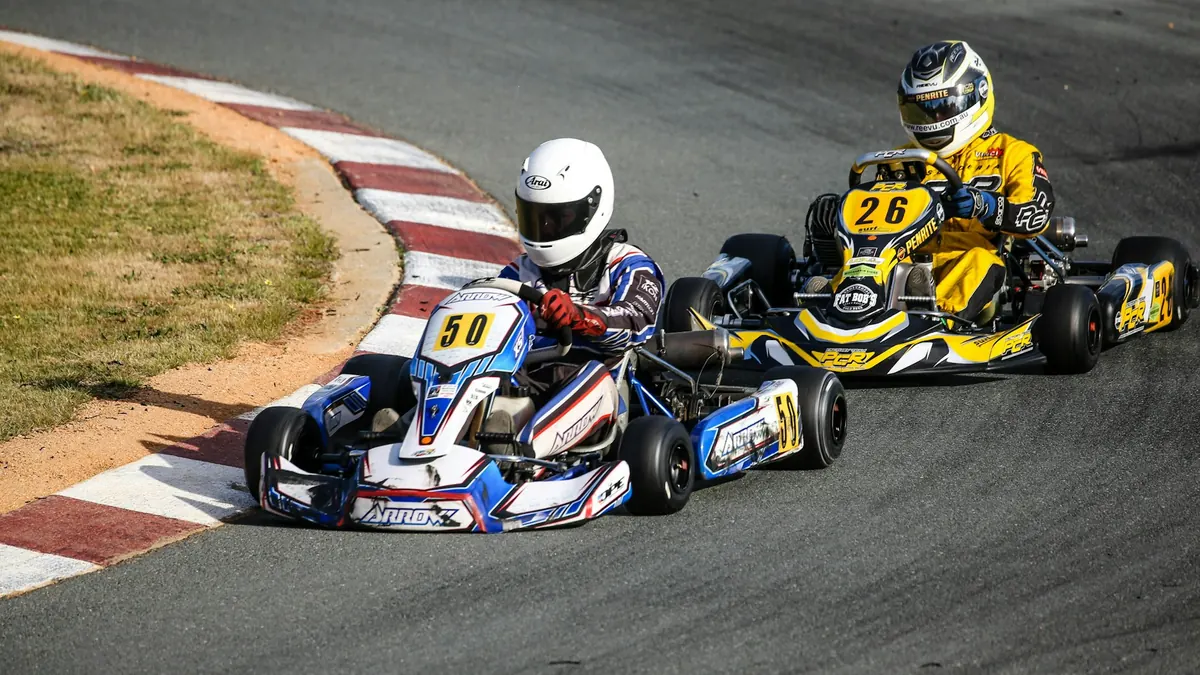
Driving a go-kart is easy to begin, but driving one quickly and consistently requires skill.
Almost anyone can press the accelerator and turn the steering wheel. The real challenge is knowing when to brake, where to position the kart, how to approach a corner, and when to accelerate again.
The fastest drivers are not necessarily those who take the biggest risks. They are usually the ones who understand their kart, use the available grip effectively, and repeat good driving techniques lap after lap.
Whether you’re driving a rental kart for the first time or preparing for competitive karting, learning the fundamentals of driving technique can make an enormous difference.
In this comprehensive guide, we’ll explain racing lines, braking points, corner entry, apexes, corner exits, throttle control, weight transfer, and common handling problems. We’ll also explore practical exercises that can help you become a smoother, more confident, and more consistent karting driver.
1. Why Driving Technique Matters More Than Raw Speed
When beginners want to improve their lap times, they often focus on one thing: going faster.
They accelerate harder, brake later, and turn the steering wheel more aggressively.
Unfortunately, these habits can make them slower.
A kart has a limited amount of grip available from its tires. Every steering, braking, and acceleration input places demands on that grip.
If you ask too much from the tires at once, the kart may slide, push wide, or lose momentum.
A good driver tries to make the best possible use of available grip while minimizing unnecessary speed loss.
The three foundations of fast karting
Smoothness
Smooth steering, braking, and throttle inputs help keep the kart balanced.
Consistency
A fast lap is valuable, but being able to repeat similar lap times is even more important for long-term improvement and racing.
Track awareness
Understanding what comes next allows you to prepare for corners rather than reacting at the last moment.
These principles apply to rental karting, four-stroke racing, two-stroke competition, and electric karts, although the precise techniques must be adapted to each machine.
If you’re new to the sport, our complete beginner’s guide to karting explains the fundamentals before you begin working on advanced driving techniques.
2. Start With the Correct Driving Position
Before working on racing lines, make sure you’re sitting properly.
A poor seating position can reduce steering precision, make braking more difficult, and cause unnecessary fatigue.
How to position yourself
Sit fully back in the seat with your body supported.
Hold the steering wheel with both hands in a comfortable, balanced position, commonly around the nine-and-three positions.
Keep your arms slightly bent rather than fully extended.
Your legs should allow you to operate the pedals without stretching or lifting yourself out of the seat.
If the rental kart has adjustable pedals or a movable seat, ask the staff to help you find a suitable position before driving.
Why posture matters
Kart steering can require significant physical effort, especially in competition machines.
If you’re reaching too far forward, you may struggle to make precise steering inputs.
If your legs are too cramped, braking and throttle control may become uncomfortable.
A stable seating position also helps you sense how the kart is behaving.
Avoid unnecessary body movements
New drivers sometimes lean dramatically into corners, imitating motorcycle riders.
In most conventional sprint karting situations, large body movements are unnecessary and may disturb the kart’s balance.
Keep your upper body reasonably stable and focus on accurate steering and pedal control.
More advanced body-position techniques can vary with kart setup, conditions, and coaching advice.
3. Look Ahead: One of the Most Important Karting Skills
A common beginner mistake is looking directly in front of the kart.
This makes everything happen too quickly.
By the time you notice a corner, you may already be late on the brakes or poorly positioned for the turn.
Experienced drivers look farther ahead.
Where should you look?
On a straight, look toward the upcoming braking area and corner.
As you approach the corner, shift your attention toward the turn-in point.
During the turn, look toward the apex and then the corner exit.
As you unwind the steering, begin looking toward the next section of track.
The idea is to guide the kart toward where you want to go, rather than staring at the asphalt immediately in front of you.
Avoid target fixation
If you stare at a barrier, another kart, or the outside edge of the track, you may unconsciously steer toward it.
Keep your vision directed toward the safe path through the corner.
This does not mean ignoring nearby drivers. You must remain aware of traffic and use peripheral vision appropriately.
Practice exercise: The vision lap
During a session, dedicate several laps to looking farther ahead.
Do not attempt to set a personal record.
Instead, identify the next corner earlier than usual and notice how much more time you have to prepare.
Many beginners discover that improved vision makes their steering and braking smoother almost immediately.
4. Understanding the Racing Line
The racing line is the path a driver chooses through a corner or sequence of corners to minimize lap time.
It is not necessarily the shortest possible distance.
Sometimes a slightly longer path allows the kart to maintain more speed, accelerate earlier, or prepare for the next corner.
The classic outside–inside–outside line
For many isolated corners, a useful starting point is:
- Approach from the outside of the track.
- Turn toward the inside of the corner.
- Pass near the apex.
- Allow the kart to move back toward the outside on exit.
This creates a larger turning radius than hugging the inside edge throughout the corner.
A larger radius can allow the kart to negotiate the corner with less steering angle and less speed loss.
However, this is only a starting principle.
The ideal line depends on the corner shape, track width, kart performance, available grip, and the corners that follow.
Why the shortest line is not always fastest
Imagine two drivers approaching the same bend.
Driver A takes a very tight line, covering less distance but slowing significantly.
Driver B takes a slightly wider line, travels farther, but maintains more speed.
If Driver B’s speed advantage is large enough, the wider line produces a faster lap.
The goal is not to minimize distance alone.
The goal is to minimize time.
5. What Is an Apex?
The apex is the point where the racing line comes closest to the inside of a corner.
It is an important reference point because it helps determine how the kart enters and exits the turn.
There are three commonly discussed approaches.
Geometric apex
A geometric apex is approximately associated with the middle of a simple, constant-radius corner.
It can be a useful theoretical reference, but it is not automatically the fastest choice.
Early apex
An early apex occurs when the kart reaches the inside of the corner relatively early.
This may initially feel fast because the driver turns toward the inside sooner.
However, it often leaves the kart poorly positioned for the exit.
The driver may need to reduce throttle or add steering to avoid running wide.
Late apex
A late apex occurs farther around the corner.
The driver delays the approach to the inside, often creating a straighter exit.
This can be especially valuable when the corner leads onto a long straight.
A strong exit may allow the kart to carry a speed advantage for the entire following straight.
Which apex should you use?
There is no universal answer.
A late apex is often useful when exit speed is especially important.
An earlier or more geometric apex may work better in other situations.
The best line must account for the entire sequence of corners, not just one turn.
6. Corner Entry, Mid-Corner and Exit
Every corner can be divided into three phases.
Understanding these phases makes it easier to identify where you’re losing time.
Phase 1: Corner entry
This is the approach and initial turning phase.
Your objectives are to:
- Position the kart correctly.
- Reduce speed as necessary.
- Release braking appropriately.
- Begin turning at a suitable point.
An overly aggressive entry can make the kart unstable or force you to slow down later.
Phase 2: Mid-corner
This is where the kart approaches or passes the apex.
Your objectives are to:
- Maintain a balanced kart.
- Avoid unnecessary steering corrections.
- Use available grip efficiently.
- Prepare for acceleration.
Too much steering can scrub speed and increase tire sliding.
Phase 3: Corner exit
This is where you begin opening the steering and accelerating toward the next section.
Your objectives are to:
- Apply throttle progressively as grip permits.
- Avoid excessive sliding.
- Use the available track width safely.
- Build speed for the next straight.
On many circuits, corner exit is particularly important because a speed advantage can continue down the following straight.
The key lesson
A driver who enters a corner slightly slower but exits cleanly may be faster overall than someone who enters aggressively and struggles to accelerate afterward.
7. Braking Techniques: How to Slow Down Efficiently
Braking is one of the most important skills in karting.
Beginners often believe that braking later always produces a faster lap.
In reality, braking at the correct point—and releasing the brakes correctly—is more important than simply waiting as long as possible.
Identify a braking reference
Choose a fixed, visible reference near the track.
Examples include:
- A distance marker.
- A permanent sign.
- A distinctive section of pavement.
- A fixed feature beside the circuit.
Avoid relying on temporary objects that may move between sessions.
Your reference helps you brake consistently.
Brake in a controlled manner
For a beginner, a useful baseline is to perform most significant braking while the kart is travelling relatively straight.
Apply the brake decisively but within the grip available.
Then release it smoothly as you approach the turn-in point.
The exact braking method depends on the kart’s brake system, tires, track surface, and conditions.
Why abrupt braking can cause problems
A sudden brake application can overload the tires.
If the wheels lock, the kart may slide and become difficult to control.
The result may be a longer stopping distance, reduced steering control, and a poor corner entry.
Avoid unnecessary coasting
Coasting means travelling without meaningful throttle or braking input.
Some coasting is appropriate, but excessive coasting can waste time.
As your technique improves, aim for deliberate transitions between acceleration, braking, and cornering rather than long periods of indecision.
Practice exercise: Consistent braking
Choose one corner with a clear braking reference.
Use the same reference for several laps while maintaining a comfortable, controlled speed.
Focus on repeating the same braking pressure and release.
Once you can do this consistently, make small adjustments within the track’s rules and your skill level.
Never experiment with braking limits when doing so could endanger other drivers.
8. Trail Braking: An Advanced Technique
Trail braking involves gradually releasing braking pressure while beginning to steer into a corner.
It can help manage weight transfer and influence the kart’s rotation.
However, it is more advanced than basic straight-line braking.
Why can it help?
When braking, weight transfers toward the front of the kart.
Depending on the chassis and conditions, this can affect front-tire grip and the kart’s willingness to turn.
A carefully controlled release of braking pressure can help the driver manage the transition from braking to cornering.
Why can it be difficult?
Braking and steering both require tire grip.
Combining them too aggressively can cause sliding, instability, or loss of control.
Not all rental karts respond in the same way, and some facilities prohibit or discourage certain aggressive driving techniques.
Beginners should first master stable braking and smooth corner entry. Learn trail braking through appropriate coaching and controlled practice, not by attempting dramatic late-braking manoeuvres during public rental sessions.
9. Throttle Control: When Should You Accelerate?
A common mistake is accelerating too early while the kart is still turning sharply.
This may cause the kart to run wide or lose traction.
The correct throttle point depends on how much grip is available and how quickly the steering can be unwound.
Progressive acceleration
As you pass the apex and begin opening the steering, increase throttle according to the kart’s response.
On some low-powered karts, full throttle may be appropriate through certain corners.
On more powerful machines or slippery surfaces, a more gradual application may be necessary.
Avoid unnecessary steering while accelerating
The tires must handle cornering forces and acceleration forces.
If you demand too much of both at the same time, grip may be exceeded.
A clean exit often involves reducing steering angle as acceleration increases.
Don’t confuse wheelspin with speed
Spinning the driven tires can feel dramatic, but it often reduces forward acceleration.
The objective is to convert available power into useful movement, not tire noise.
10. Understeer and Oversteer Explained
Two terms appear frequently in karting discussions: understeer and oversteer.
Understanding them helps you diagnose handling problems.
Understeer
Understeer occurs when the kart turns less than the driver intends.
You turn the steering wheel, but the kart continues pushing toward the outside of the corner.
Possible contributing factors include:
- Excessive entry speed.
- Too much steering angle.
- Insufficient front grip.
- An unsuitable driving line.
- Kart setup or tire conditions.
What should you do?
Avoid automatically adding more steering.
More steering angle can increase tire scrubbing without improving the turn.
Instead, reduce the demand on the tires, regain control, and review whether your entry speed or line was appropriate.
Oversteer
Oversteer occurs when the rear of the kart rotates more than intended.
Possible contributing factors include:
- Abrupt braking or weight transfer.
- Excessive throttle for available grip.
- Sudden steering inputs.
- Low-grip conditions.
- Setup characteristics.
What should you do?
Stay calm and make controlled corrections appropriate to the situation.
Avoid abrupt pedal or steering reactions that could worsen the instability.
If you repeatedly experience unpredictable handling, stop and consult track staff or a qualified instructor.
Why handling problems matter
Understeer and oversteer are not simply dramatic effects.
Both can reduce speed, increase tire wear, and make the kart harder to control.
A balanced kart driven smoothly is generally more effective than one that slides excessively.
11. Weight Transfer and Kart Balance
Weight transfer describes how loads on the tires change during acceleration, braking, and cornering.
Even though a kart sits close to the ground, these effects remain important.
Under braking
Load shifts toward the front tires.
This changes the grip available at each end of the kart.
Under acceleration
Load shifts toward the rear tires.
The effect depends on the kart’s geometry, engine output, and track conditions.
During cornering
Load transfers toward the outside tires.
Because many sprint karts have no differential and use a solid rear axle, chassis geometry and weight transfer are important to allowing the kart to rotate through corners.
A properly functioning kart may unload its inside rear tire during cornering, helping the rear wheels negotiate different paths.
Why smooth inputs help
Abrupt steering and pedal movements can produce rapid load changes.
These changes may upset the kart’s balance.
Smooth inputs allow the driver to manage weight transfer more predictably.
12. How to Drive Different Types of Corners
Not every corner should be approached the same way.
Hairpins
A hairpin is a very tight corner that requires substantial direction change.
A useful approach is to:
- Brake early enough to remain controlled.
- Avoid turning too early.
- Consider a later apex when it benefits the exit.
- Accelerate as the kart straightens.
A poor hairpin exit can be particularly costly if a long straight follows.
Fast sweeping corners
These corners reward stability and precise steering.
Excessive steering input can scrub speed.
Look far ahead and use a smooth, continuous path where appropriate.
Chicanes
A chicane is a sequence of alternating corners.
The fastest way through the first corner may not produce the fastest overall sequence.
Often, positioning the kart correctly for the second corner is more important than maximizing speed through the first.
Consecutive corners
When several corners are connected, think of them as one problem.
You may need to sacrifice some speed in an earlier corner to achieve a better exit from the final one.
Corners leading onto long straights
These deserve special attention.
A small improvement in exit speed may produce a benefit throughout the following straight.
13. How to Improve Lap Times Without Taking More Risks
Improvement should come from better technique, not from unsafe driving.
Establish a baseline
Begin by driving several controlled laps.
Record your lap times if the facility provides timing.
Do not judge yourself based on a single lap.
Focus on consistency
Compare several consecutive laps.
If your times vary widely, work on repeating braking points, racing lines, and throttle application.
Change one thing at a time
Choose one corner or technique to improve.
For example, experiment with a slightly different turn-in point while keeping your braking consistent.
Changing multiple things at once makes it difficult to understand what caused the result.
Review the entire lap
A gain in one corner may create a loss in the next.
Evaluate whether a change improves the complete lap rather than only one section.
Use coaching when possible
A qualified instructor can often identify habits that are difficult to notice from the driver’s seat.
Good coaching can save time and help prevent unsafe experimentation.
14. Rental Karting vs. Competition Karting: Technique Differences
The fundamental principles remain similar, but the driving experience can differ significantly.
Rental karts
Rental karts are often heavier and may have more protective bodywork.
Some have relatively modest engine output, making momentum preservation particularly important.
Avoiding unnecessary steering and maintaining a clean line can be very effective.
However, rental fleets differ widely. Electric karts and performance-oriented rental models may require different throttle techniques.
Competition karts
Competition karts are generally more responsive.
Changes in braking, steering, tire condition, and setup may be more noticeable.
The driver may need to pay closer attention to tire grip, chassis balance, and corner-exit traction.
Higher-performance categories also place greater demands on physical fitness and concentration.
The important takeaway
Don’t assume that a technique learned in one kart transfers perfectly to another.
Adapt your driving to the machine, the surface, and the rules of the facility.
Rental karting is an accessible way to develop basic driving skills. Our rental karting guide covers the experience, safety considerations, and practical advice for beginners.
15. Overtaking and Racing Etiquette
Driving quickly is only one part of karting.
When other drivers are on the track, awareness and respect become essential.
Plan overtakes
A good overtaking opportunity often begins with a better exit from the previous corner.
Rather than forcing a move from too far behind, focus on building speed and positioning yourself appropriately.
Avoid desperate late-braking moves
Trying to pass by braking far beyond your normal reference can lead to contact or loss of control.
An overtake is only worthwhile if it can be completed safely and within the rules.
Leave appropriate room
Respect other drivers’ space and the applicable racing regulations.
Follow flags and instructions
Always obey marshals, flags, speed restrictions, and track-specific rules.
Rental sessions are not automatically races. Some facilities prohibit aggressive overtaking or competitive contact.
Never use contact as a technique
Karting is a motorsport, but deliberate contact is not a legitimate way to improve lap times.
Drivers interested in moving beyond recreational sessions can explore our guide to starting kart racing in Québec to understand the steps involved in joining organized competition.
16. Karting in Wet Conditions
Rain changes how a kart behaves.
Grip levels can fall significantly, braking distances may increase, and familiar racing lines may no longer provide the best traction.
Reduce speed and increase your margin
Begin cautiously.
Use gentler inputs and allow more room for braking.
Look for available grip
The usual dry racing line may become slippery when wet.
Alternative lines can sometimes provide better traction, but the safest and quickest route depends on the surface and conditions.
Be gentle with the controls
Abrupt braking, steering, or acceleration can cause sliding.
Smoothness becomes especially important.
Respect the facility’s decisions
Outdoor karting facilities may suspend sessions during heavy rain, lightning, standing water, or other hazardous conditions.
Never assume a track is safe simply because it is open.
17. Physical Fitness and Mental Focus
Karting can be physically demanding, particularly in competition machines.
Neck and upper-body endurance
Cornering forces and steering effort can fatigue the neck, shoulders, arms, and core.
Concentration
A lap requires many small decisions.
Mental fatigue can affect braking references, visual awareness, and consistency.
Hydration
Even short sessions can be tiring, especially in hot weather.
Drink water and take appropriate breaks.
Recovery
If your hands, arms, or neck become too fatigued to control the kart properly, stop driving.
A tired driver is more likely to make mistakes.
18. A Practical Training Plan for Beginners
You don’t need a competition kart to practice deliberately.
Here is a simple five-session progression.
Session 1: Vision and posture
Focus on sitting correctly and looking farther ahead.
Don’t chase lap records.
Session 2: Racing lines
Choose consistent entry, apex, and exit references.
Concentrate on using the available track width appropriately.
Session 3: Braking
Practice consistent braking points and smooth brake release.
Session 4: Corner exits
Focus on reducing unnecessary steering and accelerating cleanly.
Session 5: Consistency
Aim to produce several laps with similar times while remaining controlled.
After each session, write down:
- One technique that improved.
- One corner that remains difficult.
- One goal for your next visit.
This simple habit can make practice much more productive.
Parents introducing younger drivers to the sport can also consult our karting for kids and parents guide for advice on choosing an appropriate starting environment.
19. Common Beginner Karting Mistakes
Braking too late
Late braking can compromise the entire corner.
Better approach: Find a repeatable braking reference and prioritize a clean exit.
Turning too early
An early turn-in can leave you running wide on exit.
Better approach: Look farther ahead and choose the apex based on the corner that follows.
Using too much steering
Excessive steering scrubs speed and can cause understeer.
Better approach: Reduce entry speed if necessary and aim for one smooth steering input.
Accelerating before the kart is ready
Too much throttle while turning can reduce traction.
Better approach: Match acceleration to available grip and steering angle.
Looking too close to the kart
This encourages reactive driving.
Better approach: Shift your vision toward the next reference point.
Trying to improve every corner at once
Too many changes make progress difficult to measure.
Better approach: Work on one technique or section at a time.
Comparing only the fastest lap
One exceptional lap doesn’t necessarily indicate strong technique.
Better approach: Evaluate consistency across several laps.
Ignoring safety rules
No lap time is worth risking an injury.
Better approach: Respect track instructions, flags, and other drivers at all times.
Frequently Asked Questions
What is the most important karting technique for beginners?
Looking ahead, using a consistent racing line, and braking smoothly are excellent starting points. Together, they help drivers make more predictable decisions.
Should I brake before or during a corner?
Beginners should generally perform most substantial braking while travelling relatively straight. More advanced braking techniques can be learned with appropriate instruction.
Is a late apex always faster?
No. A late apex can improve corner exit in some situations, especially before a long straight, but the ideal apex depends on the track layout.
Why does my kart slow down when I turn too much?
Excessive steering can increase tire scrubbing and sliding, converting useful momentum into heat rather than forward movement.
How can I improve my karting lap times?
Practice consistent braking references, improve your vision, reduce unnecessary steering, and focus on clean corner exits. Compare multiple laps rather than a single best time.
Should I use both pedals at the same time?
Pedal techniques vary by kart and racing discipline. Beginners should follow the facility’s instructions and avoid overlapping brake and throttle inputs unless specifically trained to do so.
Do racing lines change in the rain?
They can. Wet surfaces may have different grip characteristics, and a line that works well in dry conditions may be less effective when wet.
Is rental karting useful for learning racecraft?
Yes. Rental karting can help develop vision, consistency, racing lines, and traffic awareness, especially when combined with structured practice.
Conclusion: Smooth, Consistent Driving Creates Speed
Fast karting is not about turning the wheel harder, braking later at every corner, or taking unnecessary risks.
It’s about understanding the track, managing grip, and making deliberate decisions.
A good driver looks ahead, chooses an effective racing line, brakes at a repeatable point, and prepares for a strong corner exit.
With practice, these techniques become more natural. Instead of reacting to each corner, you’ll begin anticipating what the kart needs.
Whether your goal is to improve your rental karting lap times or eventually compete in Québec, the fundamentals remain the same: precision, consistency, and control.
At DNA Karting, we believe that learning the fundamentals is the best way to become a faster and safer driver.
Continue learning: Explore our guides How to Get Started in Karting: The Complete Beginner’s Guide, Types of Go-Karts Explained, and How Much Does Karting Cost in Québec? to develop your knowledge of the sport.
