



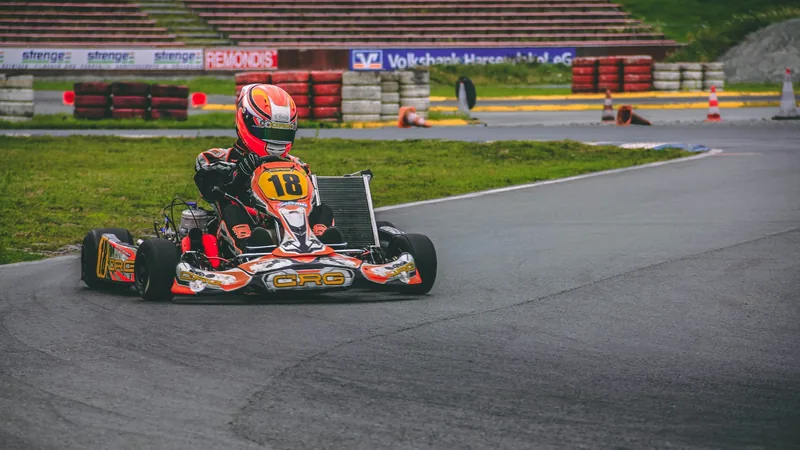
Braking is one of the most important skills in karting, yet it is frequently misunderstood. Many beginners assume that better braking means waiting longer before pressing the pedal. In reality, effective braking is about reducing speed by the right amount, at the right place, while keeping the kart stable and ready to turn.
A driver who brakes too early may lose unnecessary time. A driver who brakes too late may enter the corner too quickly, lose grip, make steering corrections or compromise the next acceleration phase. Even a well-chosen braking point can produce an inconsistent result if the driver applies or releases the pedal differently from one lap to the next.
Good braking combines three abilities: selecting a repeatable braking reference, controlling how quickly the kart slows down, and releasing the brake at a moment that supports a predictable corner entry.
This DNA Karting guide focuses specifically on those abilities. It explains how braking works, why different karts respond differently, how to recognize common mistakes and how to practise braking systematically without turning every session into an attempt to set a personal record.
1. What Effective Braking Actually Means
The purpose of braking is not simply to make a kart slower. It is to prepare the vehicle for the next change of direction.
A successful braking phase should accomplish several things:
- Reduce speed enough for the approaching corner.
- Keep the kart sufficiently stable for accurate steering.
- Avoid unnecessary wheel lockup or sliding.
- Allow the driver to release the brake in a controlled manner.
- Produce a repeatable entry speed and vehicle response.
The objective is to complete the required deceleration efficiently, without sacrificing the control needed for the corner.
This is why braking cannot be judged only by how late it begins.
Consider two drivers approaching the same corner.
The first waits until the last possible moment, applies the brake abruptly and arrives at the turn-in point with excessive speed. The kart becomes unstable, requiring extra steering and further speed reduction.
The second begins braking slightly earlier, slows down predictably and releases the pedal smoothly before steering into the corner.
Although the first driver started braking later, the second may carry more useful speed through the corner and complete the section more efficiently.
The key distinction is between late braking and effective braking.
For a broader introduction to steering, vision and general kart control, see our complete guide to karting driving techniques. Here, we will concentrate on the braking process itself.
2. Understand How Kart Brakes Work
Before developing a braking technique, it helps to understand the vehicle’s braking system.
Unlike most modern passenger cars, conventional racing karts generally do not have anti-lock braking systems. Their brakes can lock the wheels if the driver applies more braking force than the available grip can support.
The braking arrangement also varies by kart.
Rear-brake karting systems
Many conventional direct-drive racing karts use a braking system acting primarily on the rear axle.
When the driver presses the brake pedal, braking torque slows the rear wheels.
If the braking demand becomes excessive, the rear wheels can lock or lose longitudinal grip. This can make the kart unstable, especially when steering is added.
Rear-brake systems require careful coordination between pedal pressure, vehicle balance and steering.
Karts with front and rear brakes
Some racing kart categories use braking systems that act on both the front and rear wheels.
The braking behaviour may differ because the distribution of braking force and available tire grip changes how the vehicle decelerates.
A technique that works well in one kart may not produce the same result in another.
Rental kart braking systems
Rental karts are designed around operational durability, accessibility and the needs of a broad range of drivers.
Their braking systems and pedal feel can differ considerably from competition karts.
Some have relatively progressive responses, while others may feel more abrupt. The amount of pedal travel and force required can also vary.
Never assume that the braking response of one kart will be identical to another, even at the same facility.
For more background on these equipment differences, read our guide to the different types of go-karts.
Why the braking system matters to technique
The essential principle is that the driver must adapt pedal pressure to the kart’s actual response.
There is no universal braking force, pedal position or stopping distance that applies to every kart.
Before attempting to improve performance, become familiar with how the particular vehicle slows down under normal, controlled braking.
If the pedal feels abnormal, braking is inconsistent for no apparent reason, or the kart does not respond as expected, stop driving and report the issue to the operator or mechanic.
Do not attempt to compensate for a suspected mechanical fault through more aggressive driving.
3. Finding a Reliable Braking Point
A braking point is the location where the driver begins to apply the brakes for an approaching corner.
Finding a useful braking point is one of the first steps toward consistent karting.
Why braking references are important
Without a reference, drivers often brake based only on instinct.
One lap, they begin slowing down early. On the next, they wait longer because they feel more confident.
These variations make it difficult to understand whether a change in lap time resulted from better technique or simply from a different approach speed.
A fixed reference gives the driver a starting point that can be repeated and evaluated.
Choosing a reference
A useful braking reference should be easy to recognize while looking ahead.
Possible examples include:
- A permanent trackside sign.
- A distinct marking on the asphalt.
- A fixed barrier feature.
- A clearly visible change in the track environment.
- An approved braking marker provided by the circuit.
Choose stable features rather than objects that may move between sessions.
Do not focus so intensely on the reference that you lose awareness of other drivers or the track ahead.
Establishing the initial braking point
Begin conservatively.
On a familiar section of track, select a braking reference that allows enough distance to reduce speed comfortably before the corner.
Repeat the approach several times at a similar speed.
Observe whether the kart reaches the intended turn-in area in a stable condition.
Only after the process becomes consistent should you consider adjusting the reference.
Moving the braking point
If the kart consistently slows down more than necessary, the braking point may be earlier than required.
If the kart repeatedly arrives too quickly, the reference may be too late, the braking pressure may be insufficient, or the approach speed may be different.
Change only one variable at a time.
For example, move the braking point a small, recognizable distance while keeping the rest of the technique unchanged.
Avoid making large changes simply to discover the latest possible braking point.
A critical distinction: reference versus braking distance
The braking point is where braking begins.
Braking distance is the distance travelled while slowing down.
The two are related but not identical.
Braking distance depends on approach speed, grip, vehicle characteristics, braking force and other conditions.
A reference that works during one session may need adjustment when these factors change.
4. Applying Brake Pressure Correctly
Once the braking point is established, the next skill is controlling pedal pressure.
Effective braking is not necessarily gentle braking. It involves applying enough force to slow the kart efficiently while remaining within the available grip.
The initial application
When approaching a corner, release the accelerator and apply the brake in a deliberate, controlled manner.
For many dry-track competition situations, substantial braking pressure may be appropriate while the kart is travelling straight.
However, the exact rate and amount of pressure depend on the kart, its braking system and the available grip.
An abrupt pedal movement that immediately exceeds available grip can lock the wheels or destabilize the vehicle.
The goal is a firm, repeatable application rather than a sudden uncontrolled impact on the pedal.
Maintaining useful pressure
During the main deceleration phase, the driver should use sufficient pressure to reduce speed without unnecessary sliding.
If the kart begins to lock a braked axle, the available grip has been exceeded.
The appropriate response is to reduce braking demand enough to restore rolling grip and control, rather than continuing to hold excessive pressure.
Repeated lockups are not evidence of an effective technique.
They can reduce control, create tire wear and make corner entry unpredictable.
Progressive braking does not mean weak braking
The term progressive braking is sometimes misunderstood.
It does not mean that every braking phase must begin with extremely light pressure and increase slowly.
Rather, it means that pedal force is controlled and adapted throughout the braking event.
A driver may use strong initial pressure in a suitable situation and then progressively reduce that pressure as the kart approaches the corner.
In other conditions, a more gradual initial application may be necessary.
What matters is that the braking input remains deliberate and within the available grip.
5. Weight Transfer: Why the Kart Changes Balance Under Braking
Braking affects more than speed.
When a kart decelerates, its inertia creates a forward load transfer. The normal force carried by the front tires generally increases while the rear tires carry less.
This change affects how much grip is available at each end of the kart.
What happens to the front tires?
Under braking, additional vertical load is transferred toward the front axle.
This can improve the front tires’ ability to generate steering force, although tire grip does not increase in a perfectly proportional manner with load.
The effect becomes particularly relevant as the driver prepares to turn.
What happens to the rear tires?
As load transfers forward, the rear tires carry less vertical load.
On a kart with rear brakes, this can make excessive braking pressure especially problematic.
If the rear tires are asked to provide more braking force than their available grip permits, they may slide or lock.
When steering is introduced, the rear tires must also contribute lateral grip.
This is one reason why aggressive braking combined with steering can create instability.
Why smooth transitions matter
The kart’s balance changes as the driver applies and releases the brake.
Sudden changes in pedal pressure can create abrupt changes in deceleration and vehicle response.
A controlled transition makes the kart’s behaviour easier to predict.
It is important to understand that smoothness does not mean eliminating weight transfer. Weight transfer is a normal consequence of braking.
The driver’s objective is to manage it rather than allow it to become unpredictable.
A practical way to recognize weight transfer
During a permitted practice session, pay attention to the kart’s behaviour as you reduce brake pressure.
Does the steering response change?
Does the rear become more stable as braking force decreases?
Does the kart respond differently when you release the pedal abruptly compared with a controlled release?
These observations can help you connect pedal inputs with vehicle balance.
Do not deliberately provoke wheel lockup or instability to study the effect.
6. Brake Release: The Most Overlooked Part of Braking
Many drivers concentrate on where they begin braking and how hard they press the pedal.
They pay less attention to how they stop braking.
Yet brake release is a major part of preparing the kart for corner entry.
Why release timing matters
As the driver approaches the turn-in point, the kart must transition from primarily slowing down to changing direction.
The tires have a limited capacity to generate braking and cornering forces.
If the driver continues demanding substantial braking force while adding steering, the combined demand may exceed the available grip.
The result can be sliding, unstable rotation or an inability to follow the intended path.
A controlled release
For a beginner, a useful starting technique is to complete most or all of the braking while the kart is travelling straight.
Then progressively release the pedal before making a significant steering input.
The precise timing depends on the kart and the corner.
The important point is to avoid treating brake release as an afterthought.
Releasing too abruptly
A sudden release can change the kart’s balance quickly.
Depending on the vehicle and the timing, it may reduce useful front loading just as steering begins, making the response less predictable.
This does not mean that every rapid release is wrong.
Some corners and vehicle characteristics may call for a relatively quick transition.
The issue is whether the release is intentional, repeatable and appropriate for the situation.
Holding the brake too long
The opposite mistake is maintaining excessive pressure after the kart should be transitioning into the corner.
This can produce unnecessary speed loss or instability.
A driver may then add steering to compensate for a poor entry, making the situation worse.
The objective is not to stay on the brake for as long as possible. It is to finish braking at the right moment.
7. Understanding Trail Braking Without Misusing It
Trail braking is an advanced technique in which the driver retains a decreasing amount of brake pressure during the initial part of the turn.
It differs from simply braking late.
In a controlled trail-braking phase, the driver reduces braking pressure as steering demand increases.
Why some drivers use trail braking
A small amount of continued braking can influence the kart’s load distribution and help manage its response during corner entry.
In certain situations, this may support a useful rotation into the corner.
However, the effect depends on the kart, its braking system, grip and chassis behaviour.
Why it requires caution
Trail braking combines braking and steering demands.
On a rear-brake kart, excessive pressure while turning can contribute to rear-wheel lockup or instability.
On a kart with front brakes, combined longitudinal and lateral demands can also overload the front tires.
The technique is therefore not automatically faster, safer or appropriate for every driver.
When beginners should avoid it
Drivers should first become comfortable with:
- Consistent braking references.
- Stable straight-line deceleration.
- Predictable pedal pressure.
- Smooth brake release.
- Controlled corner entry.
Only after these fundamentals are reliable should advanced brake overlap be considered, ideally with qualified coaching and in an environment that permits it.
Rental karting facilities may prohibit certain aggressive techniques or require drivers to follow specific operating instructions. Those instructions always take priority.
Trail braking is not a substitute for a poor braking point
If a driver consistently enters corners too quickly, carrying the brake farther into the turn is not necessarily the solution.
The correct adjustment may simply be to begin braking earlier or reduce the entry speed.
8. Matching Braking to Corner Entry
The braking phase should prepare the kart for the corner rather than create problems that the driver must correct afterward.
This relationship is particularly important because braking and steering place different demands on the tires.
The transition from braking to steering
Think of the approach in three connected phases:
Phase 1 — Main deceleration: The kart is relatively straight, and the driver reduces speed using an appropriate amount of brake pressure.
Phase 2 — Brake release: The driver reduces pressure as the intended entry speed is reached and the turn-in point approaches.
Phase 3 — Initial steering: The driver begins changing direction with the kart sufficiently balanced and at a manageable speed.
These phases may overlap slightly in advanced driving, but they provide a useful foundation for understanding the sequence.
What happens when entry speed is too high?
An excessively fast approach can cause the kart to run wide, require excessive steering or force the driver to make additional corrections.
The mistake may appear to be a steering problem even though its cause occurred earlier in the braking zone.
Before changing the steering technique, consider whether the kart entered the corner too quickly.
What happens when entry speed is too low?
Braking much more than necessary can reduce momentum and make the kart slower through the section.
The driver may feel that the corner was easy, but that does not necessarily mean the braking phase was efficient.
A useful objective is to find a repeatable entry speed that allows the kart to respond predictably without unnecessary slowing.
Detailed racing-line selection and apex strategy are separate subjects. For this article, the important principle is that braking should support the intended corner entry.
9. Adapting Braking to Different Grip Conditions
Braking performance changes with the amount of grip available.
Even on a dry circuit, grip can vary because of tire condition, track temperature, surface texture, dust, debris and the amount of rubber deposited on the racing surface.
Cold tires
Tires may behave differently before reaching their normal operating condition.
During the first laps, use a conservative braking approach and learn how the kart responds.
Do not assume that a braking reference established later in a session will work identically at the beginning.
Changing track temperature
Track temperature can influence tire behaviour and available grip.
A reference that feels appropriate in one session may need adjustment when conditions change.
Rather than relying on a fixed rule, observe the kart’s actual response.
Surface irregularities
Bumps, surface transitions and uneven areas can affect tire contact and braking stability.
If a particular braking zone consistently produces an unexpected reaction, do not simply increase pedal pressure.
Consider the surface and seek appropriate guidance from the facility or a coach.
Dust and debris
Contaminated areas may provide less predictable grip.
Drivers should avoid unnecessary risks and follow track instructions concerning changing conditions.
Wet conditions
Water can substantially change braking performance, but detailed wet-weather technique belongs in a separate article in the DNA Karting editorial series.
For now, the essential principle is to reduce demands on the tires, allow greater margins and follow the facility’s instructions.
There is no single braking point that remains correct in every condition.
10. Common Karting Braking Mistakes and How to Correct Them
Understanding common mistakes is useful because braking problems often appear as cornering problems.
Mistake 1: Braking too late
What happens: The kart reaches the corner with excessive speed, and the driver struggles to complete the turn.
Likely causes: An overly ambitious reference, higher approach speed or insufficient deceleration.
Correction: Move the braking reference earlier and prioritize a stable entry before attempting to recover time.
Mistake 2: Braking too early
What happens: The kart slows excessively before reaching the corner.
Likely causes: A conservative reference that has not been reassessed or inconsistent pedal application.
Correction: Once the technique is stable, evaluate whether a small adjustment to the reference is appropriate.
Mistake 3: Applying excessive pressure
What happens: The braked wheels may lock, or the kart becomes unstable.
Likely causes: Pedal force exceeding the available grip.
Correction: Use a controlled application and reduce pressure when grip is exceeded.
Mistake 4: Releasing the brake abruptly
What happens: The kart’s response changes suddenly near turn-in.
Likely causes: Treating brake release as an on/off action rather than a controlled transition.
Correction: Practise reducing pressure deliberately while maintaining a repeatable entry speed.
Mistake 5: Holding the brake into the corner unnecessarily
What happens: The kart loses more speed than required or becomes unstable when steering is added.
Likely causes: Poor release timing or an attempt to correct an excessively fast approach.
Correction: Complete more of the braking while straight and simplify the transition into the turn.
Mistake 6: Changing several things at once
What happens: Lap times vary, but the driver cannot identify why.
Likely causes: Simultaneously changing the braking point, pedal pressure and steering timing.
Correction: Work on one variable during each practice exercise.
Mistake 7: Ignoring differences between karts
What happens: A familiar braking reference produces an unexpected result in another vehicle.
Likely causes: Different brake response, tire condition, kart performance or setup.
Correction: Re-establish a conservative reference whenever the vehicle or conditions change.
11. Practical Braking Drills for Karting Drivers
Braking skills improve through structured repetition.
The following exercises are intended for appropriate practice sessions where the facility permits deliberate technique work. Never perform drills in a way that interferes with other drivers or violates track rules.
Drill 1: The fixed-reference exercise
Objective: Improve consistency in where braking begins.
Choose a familiar corner with a clearly visible, fixed braking reference.
Approach at a comfortable, repeatable speed.
Begin braking at the same reference for several laps, keeping pedal application as consistent as possible.
Observe whether the kart reaches the turn-in area with similar speed and stability each time.
What to evaluate: Consistency of the reference, approach speed and entry behaviour.
Do not move the braking point later during the initial repetitions.
Drill 2: The controlled-pressure exercise
Objective: Improve pedal-force control.
Choose a braking zone that permits a comfortable, stable approach.
Keep the braking reference unchanged.
Concentrate on applying the brake deliberately rather than abruptly.
Observe whether the kart decelerates smoothly and whether any sliding or lockup occurs.
What to evaluate: Stability, repeatability and the ability to control pressure.
Avoid deliberately forcing the kart beyond its available grip.
Drill 3: The brake-release exercise
Objective: Improve the transition from deceleration to steering.
Use a familiar corner and a conservative braking reference.
Focus on reducing brake pressure in a controlled manner as the desired entry speed is reached.
Compare the kart’s response over several laps while keeping the other inputs as consistent as possible.
What to evaluate: Whether the kart remains balanced and responds predictably at turn-in.
The purpose is not to practise aggressive trail braking.
Drill 4: The braking-consistency exercise
Objective: Reduce variation from lap to lap.
Select one corner and establish a repeatable braking process.
For several consecutive laps, use the same reference and concentrate on reproducing the same pedal sequence.
If timing information is available, compare lap times, but do not judge the exercise solely by the fastest lap.
What to evaluate: Consistency of the braking process, corner entry and resulting lap times.
For a broader practice programme covering several driving skills, see our beginner plan for improving karting lap times.
Drill 5: The one-variable comparison
Objective: Learn which adjustment actually improves the result.
After establishing a stable baseline, make one small, permitted change.
For example, adjust the braking reference slightly while keeping pedal pressure and release timing as similar as possible.
Compare several laps rather than drawing conclusions from one attempt.
If the kart becomes less stable or the entry deteriorates, return to the previous reference.
What to evaluate: Whether the change produces a repeatable improvement without compromising control.
12. Measuring Braking Consistency
A driver can improve braking without sophisticated telemetry.
The most useful starting point is to observe whether the same approach produces the same result.
What to record
After a practice session, note:
- The corner or braking zone being studied.
- The braking reference used.
- Whether the kart felt stable during deceleration.
- Whether brake release was smooth.
- Whether entry speed felt excessive, insufficient or appropriate.
- Whether the same result could be repeated.
A short written note is often more useful than relying on memory after several sessions.
Using lap times carefully
Lap times provide information about the entire circuit, not one braking zone.
A faster lap does not prove that the braking technique improved. Other corners, traffic or track conditions may have influenced the result.
Likewise, a slightly slower lap may still contain a more controlled and repeatable braking phase.
Evaluate both the quality of the technique and the overall performance.
Using video or telemetry
Where permitted, video can help identify braking references and compare the timing of inputs.
Telemetry may provide more precise information about speed, braking and consistency, depending on the equipment available.
However, data requires interpretation.
A graph showing a later braking point does not automatically prove that the driver was faster or more effective through the corner.
The purpose of measurement is to understand the result, not simply to collect numbers.
13. How Braking Technique Differs Between Rental and Racing Karts
The principles of grip, deceleration and controlled inputs apply across karting, but the appropriate technique changes with the vehicle.
Rental karts
Rental karts may have different pedal responses, vehicle weights, tire characteristics and performance levels.
Drivers should prioritize predictable braking and follow the facility’s instructions.
Because rental sessions often involve participants with different experience levels, maintaining awareness of traffic is especially important.
Competition karts
Competition karts may provide stronger braking performance and more direct feedback.
Their response also depends on the braking system, tires, chassis setup and conditions.
More advanced techniques may be appropriate in organized practice with qualified instruction.
However, stronger performance does not eliminate the need for consistency.
Equipment and setup considerations
Braking problems are not always caused by driver technique.
Brake condition, tire grip, chassis characteristics and other mechanical factors can influence the result.
If the kart behaves abnormally, it should be inspected by the responsible operator or a qualified mechanic.
For drivers responsible for their own racing equipment, our beginner’s guide to racing kart maintenance explains the broader importance of regular inspection and maintenance.
14. A Simple Progression for Developing Better Braking
Rather than attempting every technique at once, build braking skill in stages.
Stage 1: Predictability
Learn how the kart responds and establish conservative braking references.
The goal is to arrive at the corner under control.
Stage 2: Consistency
Repeat the same braking sequence over several laps.
Concentrate on reducing unnecessary variation.
Stage 3: Pedal control
Refine the amount and timing of brake pressure.
Avoid wheel lockup and abrupt, uncontrolled inputs.
Stage 4: Brake release
Develop a reliable transition between slowing down and steering.
Observe how the kart’s balance responds.
Stage 5: Efficiency
Once the technique is stable, evaluate whether the braking point or pressure can be adjusted to reduce unnecessary speed loss.
Make small changes and measure their effects.
Stage 6: Advanced refinement
With appropriate experience and coaching, explore more sophisticated techniques where permitted.
Advanced methods should build on sound fundamentals rather than replace them.
15. Frequently Asked Questions About Karting Braking
Should you brake hard or gently in a go-kart?
It depends on the kart, corner and grip available. Effective braking may involve firm pressure while the kart is straight, followed by a controlled release. The objective is to decelerate efficiently without exceeding available grip.
Should you brake before turning?
For beginners, completing most or all braking before significant steering is a reliable starting point. Advanced drivers may use a controlled overlap between braking and steering in appropriate conditions.
Why does a kart slide when braking?
Possible causes include excessive brake pressure, insufficient grip, combined braking and steering demands, or mechanical issues. The specific cause depends on which wheels are losing grip and how the kart behaves.
Is trail braking necessary to be fast?
No. It is one technique that may be useful in certain situations, but consistent braking references, suitable entry speeds and controlled brake release are more fundamental.
Does braking later always improve lap times?
No. A later braking point can reduce time spent slowing down only if the kart still reaches the corner at a suitable speed and remains controllable. Braking too late can make the entire corner slower.
How can you tell whether your braking is improving?
Look for repeatable braking references, stable deceleration, predictable corner entry and reduced variation between laps. Use lap times as supporting information rather than the only measure.
Conclusion: Better Braking Comes From Better Control
Effective karting braking is not a contest to see who can wait longest before pressing the pedal.
It is a coordinated process involving braking references, pedal pressure, weight transfer, brake release and corner-entry preparation.
The strongest foundation is to brake predictably, understand how the kart responds and repeat a controlled technique before attempting more aggressive adjustments.
With structured practice, drivers can learn to reduce unnecessary speed loss while maintaining stability and confidence.
At DNA Karting, we encourage drivers to approach skill development methodically: understand the technique, practise within the rules of the facility, observe the result and improve one element at a time.
The goal is not simply to brake later. It is to brake better.
