



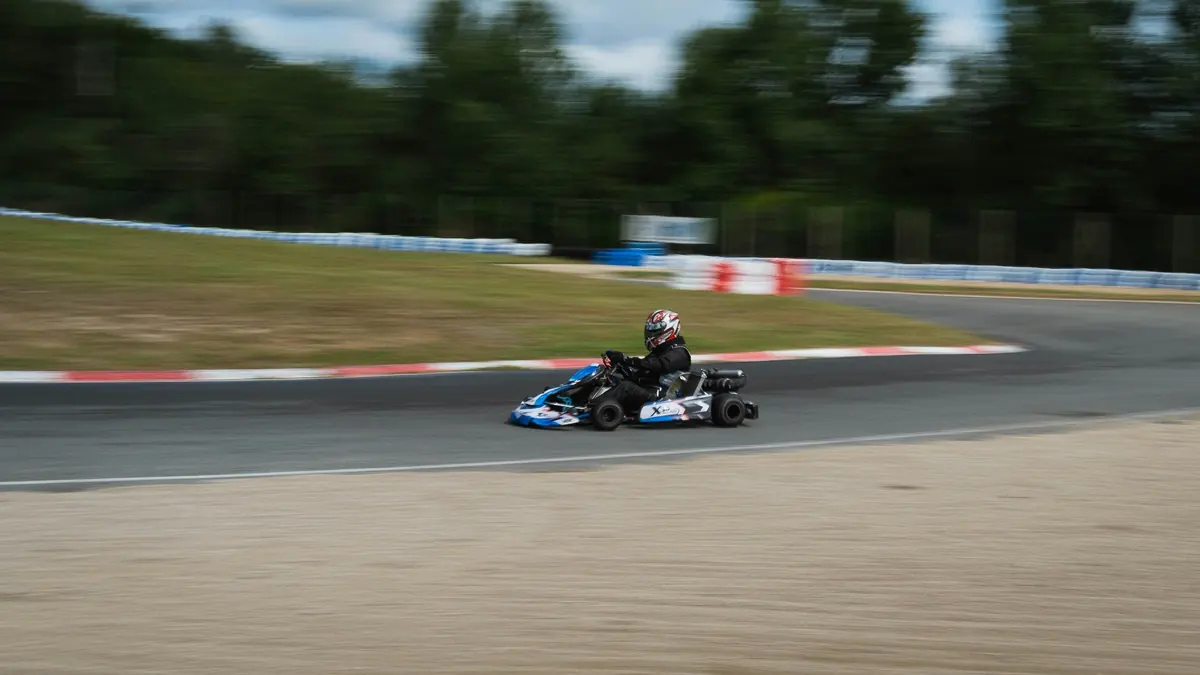
One of the most exciting parts of karting is watching your lap times improve.
Whether you’re driving rental go-karts for fun or preparing for your first competitive kart race, learning how to become faster is a rewarding challenge.
However, improving your lap times isn’t simply about pressing the accelerator harder or braking later.
The fastest drivers combine smooth steering, consistent braking, efficient racing lines, and the ability to repeat good laps.
For beginners, consistency is usually the first step toward speed.
In this guide, you’ll learn how to measure your progress, identify common driving mistakes, and follow a structured practice plan to improve your karting lap times.
1. Understand What Makes a Fast Karting Lap
A fast lap is the result of several driving techniques working together.
The most important factors include:
- Choosing an efficient racing line
- Braking at the correct point
- Carrying appropriate speed through corners
- Accelerating smoothly on corner exit
- Minimizing unnecessary steering movements
- Maintaining consistency throughout the lap
A mistake in one corner can affect your speed through the next section of the circuit.
For example, entering a corner too quickly may force you to slow down excessively before the exit.
This can reduce your speed along the following straight.
That’s why the fastest approach isn’t always the one that feels the most aggressive.
For a detailed introduction to racing lines, braking, and cornering, read our Karting Driving Techniques: The Complete Guide to Racing Lines, Braking and Cornering.
2. Start by Measuring Your Lap Times
Before trying to improve, establish a starting point.
Many rental karting facilities provide electronic lap timing, allowing drivers to review their results after a session.
Competitive karting circuits may also use timing systems or data acquisition equipment.
Record the following information whenever possible:
- Circuit name and layout
- Date and session
- Kart or equipment used
- Fastest lap time
- Average lap time
- Track conditions
- Any important observations
If you’re driving rental karts, remember that individual karts may perform differently.
Traffic, weather, tire condition, and other variables can also affect results.
Comparing times is most useful when the conditions are reasonably similar.
Example: Tracking Your Progress
| Session | Best lap | Average lap |
|---|---|---|
| Session 1 | 52.8 seconds | 54.1 seconds |
| Session 2 | 52.3 seconds | 53.2 seconds |
| Session 3 | 51.9 seconds | 52.5 seconds |
| Session 4 | 51.6 seconds | 52.0 seconds |
These times are illustrative examples, not benchmarks for a particular circuit.
Notice that both the fastest lap and average lap improve.
This suggests the driver is becoming faster and more consistent.
3. Focus on Consistency Before Maximum Speed
A beginner may occasionally complete one fast lap while making several mistakes during the rest of the session.
An experienced driver is often able to repeat similar lap times consistently.
For example:
Driver A: 51.8, 54.2, 52.9, 55.1, 52.0 seconds.
Driver B: 52.2, 52.1, 52.0, 52.3, 52.1 seconds.
Driver A records the single fastest lap, but Driver B is considerably more consistent.
For racing, consistency is valuable because it reduces mistakes and helps maintain a competitive pace.
Practice drill: Five consistent laps
During your next session:
- Drive at a comfortable pace.
- Focus on smooth inputs.
- Avoid unnecessary overtaking.
- Try to complete five consecutive laps with similar times.
- Review your results afterward.
Your objective is to reduce the variation between laps.
Once you can repeat consistent times, gradually work on improving your overall pace.
4. Improve Your Racing Line
The racing line is the path you take through a corner.
An efficient racing line helps you maintain momentum while preparing for the next section of the circuit.
A common approach involves three elements:
- Corner entry: Position the kart appropriately before turning.
- Apex: Pass near the intended inside point of the corner.
- Corner exit: Allow the kart to move toward the outside of the track as appropriate.
However, the ideal racing line depends on the corner and the layout of the circuit.
A tight corner leading onto a long straight may require a different approach than a corner followed immediately by another turn.
Practice drill: One corner at a time
Choose a corner where you frequently lose time.
During several laps:
- Use the same braking reference.
- Focus on a repeatable turning point.
- Aim for a consistent apex.
- Observe your speed and position at the exit.
- Make small adjustments on subsequent laps.
Avoid changing your braking, steering, and acceleration all at once.
By focusing on one variable, you’ll have a better chance of understanding what improves your performance.
5. Learn to Brake Smoothly and Consistently
Braking is one of the most important skills in karting.
Beginners often make two common mistakes:
- Braking too early and losing unnecessary speed
- Braking too late and entering the corner without sufficient control
The objective is to slow the kart enough to negotiate the corner efficiently while maintaining stability.
Practice drill: Establish a braking reference
Choose a safe and clearly visible reference point before a corner.
This could be a trackside marker or another fixed feature.
On each lap:
- Approach the corner at a controlled speed.
- Begin braking at your chosen reference.
- Apply the brakes smoothly and appropriately.
- Release braking pressure as required for the corner.
- Observe whether the kart reaches the desired turning point.
When you can repeat the sequence consistently, make small adjustments if conditions permit.
Never delay braking beyond your ability to maintain control.
For beginners, a predictable braking technique is more valuable than attempting extremely late braking.
6. Avoid Excessive Steering
Many beginners believe that turning the steering wheel more aggressively will make the kart corner faster.
In reality, excessive steering can reduce grip and increase tire scrub.
It may also cause the kart to lose momentum.
Signs of excessive steering can include:
- The kart sliding unnecessarily
- Difficulty maintaining a consistent line
- A noticeable reduction in corner speed
- Repeated steering corrections
Practice drill: Smooth steering inputs
During a session, concentrate on turning the steering wheel progressively.
Try to:
- Use one deliberate steering input when appropriate
- Avoid unnecessary corrections
- Keep your hands stable
- Allow the kart to follow a smooth path
The objective is not to minimize steering at all costs.
Instead, use the steering input necessary to negotiate each corner efficiently.
7. Prioritize Corner Exit Speed
Not all corners are equally important for lap time.
A corner leading onto a long straight can have a significant influence on the rest of the lap.
If you exit that corner slowly, you may lose time throughout the following straight.
This is why drivers sometimes sacrifice a small amount of entry speed to achieve a better exit.
Practice drill: Focus on the exit
Choose a corner followed by a straight.
During several laps:
- Approach the corner at a controlled speed.
- Avoid entering too quickly.
- Focus on positioning the kart for a clean exit.
- Apply the accelerator smoothly when appropriate.
- Observe how early you can accelerate without losing control.
The goal is to improve your speed at the beginning of the straight.
For some corners, a slightly slower entry can produce a faster overall lap.
8. Look Farther Ahead
Where you look influences how you drive.
Beginners often focus directly in front of the kart.
This makes it more difficult to anticipate corners and plan smooth movements.
Experienced drivers generally look farther ahead, identifying their next braking point, apex, or exit.
Practice drill: Visual reference points
During your next session:
- Look toward the corner entry while approaching.
- Shift your attention toward the apex as you begin turning.
- Look toward the exit as you progress through the corner.
- Prepare your vision for the next section of track.
Always remain aware of other drivers and immediate hazards.
Looking ahead helps you anticipate what comes next rather than reacting at the last moment.
9. Understand the Difference Between Rental and Racing Karts
The fundamentals of smooth driving apply to both rental and competitive karting.
However, different karts can require different techniques.
Rental karts
Rental karts are generally designed for durability and accessibility.
They may have:
- Lower power
- Greater weight
- Different tires
- More limited setup options
- Performance differences between individual karts
For rental karting, maintaining momentum and avoiding unnecessary sliding are often especially important.
If you’re new to recreational karting, explore our Rental Karting: The Complete Guide for Beginners.
Racing karts
Competitive racing karts are designed for performance and may respond more directly to steering, braking, and throttle inputs.
They can also require a greater understanding of:
- Tire performance
- Kart setup
- Weight transfer
- Engine characteristics
- Track conditions
If you’re considering the transition to organized racing, read How to Start Kart Racing in Québec: Licences, Classes, Clubs and Your First Race.
10. A Four-Session Karting Practice Plan
You don’t need to improve every technique during a single session.
A structured plan helps you focus on specific skills and measure progress.
The following plan can be adapted to rental karting or supervised competitive practice.
Session 1: Establish Your Baseline
Objective: Understand your current performance.
Focus on:
- Learning the circuit
- Driving safely
- Identifying braking points
- Recording lap times
- Noticing difficult corners
After the session, record your fastest lap, average lap, and observations.
Do not worry about matching the fastest drivers.
Session 2: Improve Consistency
Objective: Reduce lap-time variation.
Focus on:
- Repeating the same braking points
- Maintaining a consistent racing line
- Avoiding unnecessary steering corrections
- Completing several clean laps in succession
Compare your average lap time with Session 1.
Even if your fastest lap doesn’t improve, greater consistency is valuable progress.
Session 3: Work on Corner Exits
Objective: Improve acceleration and momentum.
Choose one or two corners that lead onto important straights.
Focus on:
- Controlled corner entry
- Smooth steering
- Maintaining traction
- Accelerating at the appropriate point
- Avoiding unnecessary sliding
Review whether your lap times become more consistent or improve.
Session 4: Combine Your Skills
Objective: Apply everything you’ve learned.
During this session:
- Use consistent braking references.
- Follow efficient racing lines.
- Look ahead.
- Prioritize smooth corner exits.
- Avoid unnecessary risks.
Afterward, compare your results with your first session.
Look for improvements in both your fastest lap and your average lap.
11. How to Analyze Your Progress
A useful practice session doesn’t end when you leave the track.
Spend a few minutes reviewing what happened.
Ask yourself:
- Which corners felt most difficult?
- Did I brake consistently?
- Was I turning too aggressively?
- Did I lose speed on corner exits?
- Were my lap times becoming more consistent?
- What should I practise next time?
Keep a simple practice log.
Example Practice Log
| Session | Main focus | Observation | Next objective |
|---|---|---|---|
| 1 | Baseline | Inconsistent braking | Improve braking references |
| 2 | Consistency | Fewer mistakes | Improve corner exits |
| 3 | Corner exits | Better acceleration | Reduce steering corrections |
| 4 | Combined skills | More consistent laps | Continue targeted practice |
You don’t need expensive data acquisition equipment to begin learning.
A lap-time printout and a few written observations can already provide useful information.
12. Common Mistakes That Prevent Faster Lap Times
Trying to drive faster everywhere
Driving more aggressively in every corner often leads to mistakes.
Instead, identify where you’re losing time and focus on specific improvements.
Braking too late
Late braking can compromise corner entry and exit.
Focus on controlled, repeatable braking.
Sliding excessively
Sliding may feel fast, but unnecessary tire scrub often reduces momentum.
Ignoring corner exits
A poor exit onto a long straight can cost more time than a slightly slower corner entry.
Changing too many things at once
If you modify several techniques simultaneously, it becomes difficult to identify what works.
Comparing times under different conditions
Weather, traffic, tire condition, and kart performance can affect lap times.
Try to compare similar sessions whenever possible.
Focusing only on the fastest lap
Your average lap time and consistency can be more informative than one exceptional lap.
13. Should Beginners Use Karting Coaching?
Coaching can be helpful for drivers who want to improve more efficiently.
A qualified instructor may help identify problems that are difficult to recognize while driving.
Coaching can focus on:
- Racing lines
- Braking technique
- Steering inputs
- Corner exits
- Visual awareness
- Racecraft
- Consistency
Some rental karting facilities offer instruction or organized driving programs.
Competitive karting clubs and teams may also provide coaching services.
Before booking, ask about the instructor’s experience, the session format, and whether the coaching is appropriate for your skill level.
14. How Much Can You Improve Your Lap Times?
There is no universal amount of time that every beginner can expect to gain.
Progress depends on:
- Your current experience
- Circuit layout
- Kart performance
- Track conditions
- Practice frequency
- Quality of instruction
- Your ability to apply feedback
A beginner may improve noticeably after learning the basic racing line and braking points.
As your skills develop, improvements may become smaller and require more detailed analysis.
Avoid setting unrealistic targets based on another driver’s performance.
Instead, measure progress against your own previous sessions.
15. Frequently Asked Questions
How can I get faster at karting?
Focus on consistent braking, efficient racing lines, smooth steering, and good corner exits. Record your lap times and practise one technique at a time.
Is braking later always faster in karting?
No. Braking too late can compromise the corner and reduce exit speed. The best braking point allows you to maintain control and negotiate the corner efficiently.
Why are my karting lap times inconsistent?
Inconsistent braking points, steering corrections, traffic, and changing track conditions can all contribute to lap-time variation.
Does sliding make a go-kart faster?
Not necessarily. Excessive sliding generally wastes momentum and can reduce traction. Controlled, efficient cornering is usually more effective.
How often should I practise karting?
The ideal frequency depends on your budget, availability, and objectives. Regular, focused sessions with clear goals can be more productive than occasional sessions without a practice plan.
Can rental karting improve my racing skills?
Yes. Rental karting can help develop racing lines, braking consistency, visual awareness, and smooth driving techniques that are useful in competitive karting.
Final Thoughts: Consistency Creates Speed
Improving karting lap times is a process of learning, practising, measuring, and refining your technique.
The goal isn’t simply to drive harder.
It’s to understand where you’re losing time and make small, repeatable improvements.
Start by establishing your baseline, develop consistent braking and steering habits, and focus on efficient corner exits.
The more consistently you can drive a clean lap, the stronger your foundation for becoming faster.
Whether you enjoy recreational karting or aspire to compete, a structured practice plan can help you make meaningful progress while keeping safety at the centre of your driving.
Continue Improving Your Karting Skills
Explore more educational resources in our Learn Karting section.
