



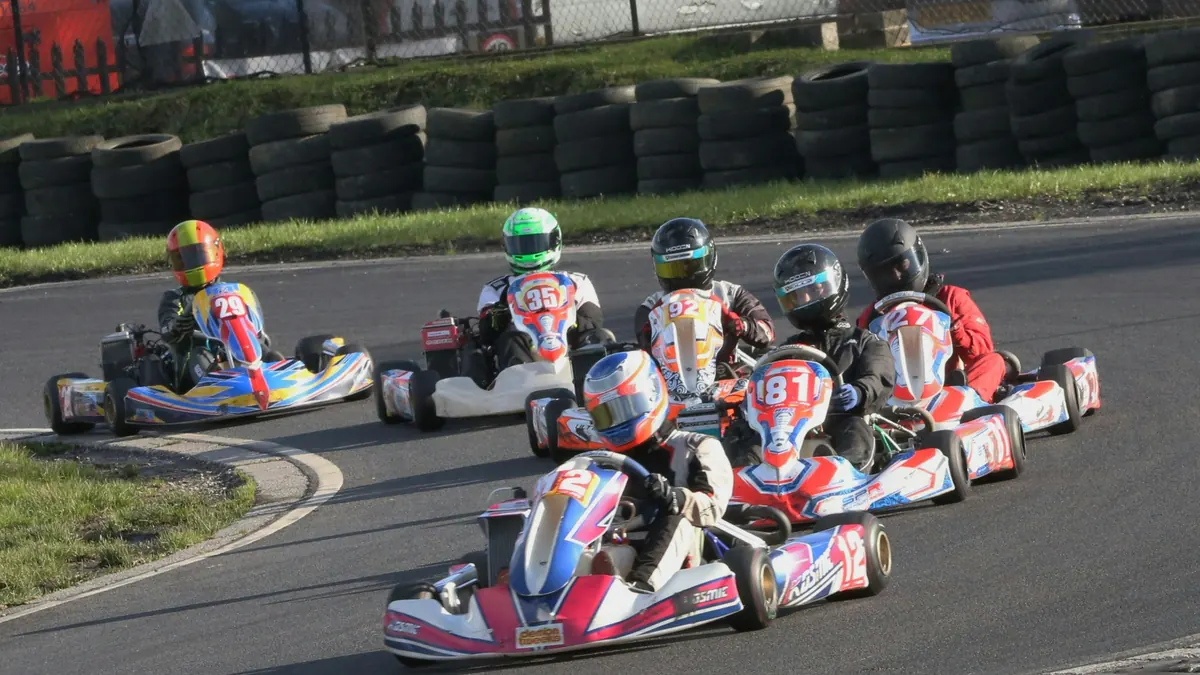
A racing line is the path a driver chooses through a corner or sequence of corners. It affects how sharply the kart must turn, how much speed it can carry and how well it is positioned for the next section of the circuit.
At first glance, the ideal racing line might seem simple: approach from the outside, turn toward the inside and exit toward the outside. That familiar outside–inside–outside pattern is a useful starting point, but it does not explain why some trajectories are faster than others.
The quickest route is not always the shortest distance. A slightly longer path can allow a larger turning radius, a more manageable change of direction or a better exit onto a straight.
Understanding these compromises is one of the foundations of efficient kart driving.
Our complete guide to karting driving techniques introduces cornering as part of overall driving fundamentals. This article examines racing-line geometry in greater detail, focusing specifically on apexes, entry and exit positions, and the relationship between consecutive corners.
1. What Is a Racing Line in Karting?
The racing line is the intended path of the kart through a section of track.
It can be described using three main reference points:
- Corner entry: Where the kart begins its approach and changes direction.
- Apex: The point, or region, where the chosen trajectory comes closest to the inside of the corner.
- Corner exit: Where the kart completes the turn and transitions toward the next section.
These points are connected. Moving the apex changes the shape of the entry and exit, while changing the entry position affects the radius available through the corner.
A racing line is therefore not simply a collection of isolated points. It is a continuous path that must work as a whole.
Why the line matters
A kart must generate lateral grip to change direction. The tighter the path at a given speed, the greater the turning demand.
A line that requires an unnecessarily sharp change of direction may force the driver to travel more slowly than a smoother alternative.
However, taking the widest possible path is not always the answer. A wider line can increase distance or leave the kart poorly positioned for the next corner.
The objective is to find the best compromise between distance, curvature, speed and what comes next.
2. Understand Corner Radius Before Choosing an Apex
Corner radius describes how sharply a path curves.
A large-radius turn is relatively gentle. A small-radius turn is tighter.
For a simplified constant-radius turn, the lateral acceleration required is proportional to the square of speed divided by radius:
Lateral acceleration = speed² ÷ radius
This relationship explains why a larger turning radius can allow greater speed when available grip and other conditions are comparable.
But real racing lines rarely follow perfect circles.
A driver may enter on one radius, tighten the trajectory near the apex and open the steering path again on exit.
Why the shortest route may not be fastest
Imagine a wide, isolated corner.
One driver takes a very tight path near the inside edge. The distance travelled is relatively short, but the turn is sharp.
Another driver begins wider, uses more of the available track and follows a gentler curve.
The second driver travels farther but may be able to maintain more speed.
Which approach is faster depends on the entire time required to complete the corner, not distance alone.
A larger radius is not always better
Using every centimetre of track can increase distance without producing a worthwhile speed advantage.
A very wide entry may also create an awkward approach to the apex.
Good racing-line selection means using width where it helps, rather than automatically following the outer edge.
3. What Is the Apex of a Karting Corner?
The apex is the point or region where the kart passes closest to the inside boundary of the corner along its chosen line.
It is a useful reference, but it should not be treated as a fixed target that every driver must reach in exactly the same way.
The ideal apex depends on the corner’s shape, the available track width and the following section.
The geometric apex
In a simple, approximately symmetrical corner, the geometric apex is near the middle of the inside arc.
A line aimed near this region may produce a balanced entry and exit.
This is a useful starting model for understanding racing-line geometry, although it does not necessarily produce the fastest trajectory.
An early apex
An early apex occurs when the kart reaches the inside of the corner relatively soon.
This may create a direct initial path, but it can leave the kart facing a tighter remaining turn.
The driver may then need to maintain a larger steering angle or sacrifice speed to avoid running out of room at the exit.
Early apexes are not inherently wrong. They can be useful in particular corner sequences or when positioning for a following turn.
The mistake is choosing an early apex without considering the consequences for the remainder of the corner.
A late apex
A late apex occurs farther around the corner.
The kart stays away from the inside boundary for longer before approaching it.
This can allow the driver to complete more of the directional change before reaching the exit, creating a more open path as the kart leaves the corner.
A late apex is often useful before a long straight, where a strong exit can be particularly valuable.
However, an excessively late apex can increase distance or reduce speed unnecessarily.
The objective is not to choose the latest possible apex, but the one that produces the best overall result.
4. How Corner Entry Position Changes the Racing Line
The position of the kart before turning influences the path available through the corner.
For a conventional single corner, approaching from the outside generally provides more room to create a larger turning radius.
This is the reasoning behind the familiar outside–inside–outside line.
Starting from the outside
A wide entry can make the corner less abrupt.
Instead of turning through a tight arc from near the inside boundary, the kart has more lateral space to change direction.
This may allow a smoother path and reduce the need for a sudden steering correction.
The trade-off of a wide entry
Moving toward the outside edge adds distance.
It may also create a poor approach if the corner changes radius or leads directly into another turn.
Therefore, the entry position should be chosen in relation to the entire corner, not merely to maximize width.
Turn-in position and apex selection
The point where the driver begins turning and the intended apex are related.
An early change of direction may lead toward an early apex, while a later change of direction can support a later apex.
The precise relationship depends on the corner geometry and the kart’s speed.
For the separate skill of managing speed and deceleration before the corner, see our guide to karting braking techniques.
Here, the focus is on the shape of the path rather than how to operate the brake pedal.
5. Why Corner Exit Speed Matters
Corner exit speed is the speed the kart carries as it completes the turn and begins the following section.
Its importance depends heavily on what follows.
A corner leading onto a long straight often rewards a trajectory that allows the kart to accelerate effectively and leave the turn with a favourable direction.
The advantage can continue down the straight
Imagine two drivers leaving the same corner.
Driver A exits slightly faster but has travelled a somewhat longer route through the turn.
Driver B follows a shorter line but exits more slowly.
If the following straight is long enough, Driver A’s speed advantage may persist for a meaningful portion of that straight.
The time gained after the corner can outweigh the extra distance travelled inside it.
This is why evaluating only the corner itself can be misleading.
The direction of the kart matters too
A fast exit is useful only when the kart is pointed appropriately for the next section.
A driver who reaches the outside boundary while still needing a major directional correction may lose the advantage of the chosen line.
A well-designed exit allows the steering path to open progressively and avoids unnecessary changes of direction.
Not every corner deserves maximum exit priority
If the next section is extremely short or immediately leads into another turn, maximizing the first corner’s exit speed may be less important.
The racing line must account for what happens next.
6. Comparing Early, Geometric and Late Apexes
Consider a simple right-hand corner followed by a straight.
| Apex choice | Typical characteristic | Possible compromise |
|---|---|---|
| Early apex | Reaches the inside sooner | May tighten the remaining exit |
| Geometric apex | More balanced entry and exit | May not maximize speed onto the straight |
| Late apex | Delays the closest approach to the inside | May sacrifice entry speed or add distance to improve exit |
These are general tendencies, not universal rules.
A corner with changing radius, unusual banking or limited track width may behave differently.
The best line must be evaluated through the complete section, not by assuming one apex type is always fastest.
7. Racing Lines Through Different Corner Shapes
Different corner geometries create different priorities.
Constant-radius corners
A constant-radius corner maintains approximately the same curvature throughout the turn.
A smooth arc that uses an appropriate amount of track width is a useful starting point.
The ideal path may still differ from a perfect geometric arc because the entry and exit connect to other parts of the circuit.
Tight hairpins
A hairpin requires a substantial change of direction.
A driver may benefit from delaying the apex so the kart can be positioned for a more favourable exit.
However, the exact line depends on how much room is available and whether another corner follows immediately.
An overly wide or delayed line can create unnecessary distance.
Decreasing-radius corners
A decreasing-radius corner becomes tighter as the driver progresses through it.
An early apex can be particularly problematic because the remaining part of the turn demands a sharper path.
Recognizing the tightening geometry helps explain why a later apex or a more conservative initial trajectory may be appropriate.
Increasing-radius corners
An increasing-radius corner opens as the kart progresses.
Because the available turning path becomes less restrictive, the optimal line may differ from that of a constant-radius corner.
A driver should consider how quickly the corner opens and where the kart needs to be positioned afterward.
Chicanes
A chicane consists of successive changes of direction.
The fastest path through the first part may not produce the fastest path through the entire sequence.
The driver must consider where the kart will be positioned for the second change of direction.
In many cases, the final exit is more important than maximizing speed through the first element.
8. How to Choose a Line Through Linked Corners
Linked corners are one of the clearest examples of why a racing line must be planned beyond a single apex.
Imagine a left-hand corner immediately followed by a right-hand corner.
If the driver uses all the available width at the exit of the first turn, the kart may end up poorly positioned for the second.
A slightly slower or tighter exit from the first corner may create a better entry into the second.
Prioritize the corner that matters most
A useful principle is to evaluate the sequence from its final exit backward.
Ask:
- Where should the kart be positioned when leaving the final corner?
- What apex supports that exit?
- Where must the kart enter the final corner?
- How should the preceding corner be approached to reach that position?
This reverse-planning method helps explain why the best line through a sequence may look unusual when each corner is considered independently.
Example: a fast corner followed by a hairpin
A driver may be tempted to maximize speed through the first corner.
But if that leaves the kart on the wrong side of the track for the hairpin, the gain may be lost immediately.
A better overall trajectory may sacrifice a small amount of speed in the first corner to create a more favourable entry into the second.
Example: a chicane leading onto a straight
When a chicane ends at the beginning of a long straight, the final change of direction often deserves particular attention.
The entry into the first element may need to be compromised to establish a better path through the second.
The fastest individual segment is not always part of the fastest complete sequence.
9. Common Racing-Line Mistakes
Understanding the geometry makes it easier to recognize why certain lines are inefficient.
Turning toward the inside too early
An early apex can leave insufficient room for the remaining corner.
The result may be a tightening exit and an additional steering correction.
Following the inside edge throughout the corner
Hugging the inside boundary may shorten the route but create an unnecessarily tight radius.
The driver may lose more time through reduced speed than is gained through the shorter distance.
Using excessive track width
A very wide line is not automatically fast.
If the additional distance produces little benefit in speed or positioning, it may be inefficient.
Ignoring the next corner
A good exit from one corner can be a poor entry into the next.
The racing line should be judged across the full sequence.
Treating the apex as the only objective
Reaching a particular apex is not proof of an efficient line.
The approach, path through the corner and exit all matter.
Copying a line without understanding its purpose
Different drivers or karts may use visibly different trajectories because of equipment characteristics, available grip or the surrounding corner sequence.
The important question is why a particular path works, not simply whether it looks familiar.
10. How to Evaluate Whether a Racing Line Works
A racing line should be assessed by its effect on the complete section.
For an isolated corner, that may mean comparing the time from a consistent point before entry to a consistent point after exit.
For linked corners, the measurement should include the full sequence and enough distance afterward to capture the effect of exit speed.
Compare like with like
Useful comparisons require reasonably similar conditions.
Differences in kart performance, traffic, grip and driving consistency can make one line appear better or worse than it really is.
Look beyond one lap
A single fast lap may not demonstrate that a trajectory is consistently effective.
Repeated observations are more informative, particularly when the differences are small.
Observe the kart’s path
Useful questions include:
- Does the kart require an abrupt change of direction?
- Does the line become unnecessarily tight after the apex?
- Is there enough room to complete the exit?
- Is the kart positioned correctly for the next corner?
- Does a wider path create a meaningful benefit?
These questions focus on geometry rather than attempting to diagnose every aspect of driving technique.
For a broader introduction to improving performance over multiple sessions, see our beginner’s guide to improving karting lap times.
11. Racing-Line Examples You Can Visualize
Example A: A single 90-degree corner
Imagine a right-hand corner with a straight before and after it.
A line that begins on the outside, approaches the inside near the middle of the turn and opens toward the outside on exit provides a useful geometric starting point.
The ideal apex may shift depending on whether the preceding or following straight is more important.
Example B: A hairpin followed by a long straight
Imagine a tight right-hand hairpin leading onto a substantial straight.
A later apex may allow the kart to complete more of its directional change before the exit.
The driver may sacrifice some speed on entry to obtain a more favourable exit.
Example C: Two corners in opposite directions
Imagine a left-hand bend followed immediately by a right-hand bend.
Using the full outside width at the first exit may create an awkward approach to the second.
A compromised first line can be faster overall if it improves the second corner.
Example D: A tightening corner
Imagine a corner that begins gently and becomes tighter.
An early apex may force a sharp change of direction later in the turn.
A line that accounts for the decreasing radius can avoid this geometric problem.
These examples are simplified models. Real tracks introduce additional variables, including changes in surface, elevation, banking and available width.
Frequently Asked Questions
What is the best racing line in karting?
There is no single line that is best for every corner. The ideal trajectory depends on corner geometry, grip, kart characteristics and the sections before and after the turn.
What does apex mean in karting?
The apex is the point or region where the chosen racing line comes closest to the inside of the corner.
Is a late apex always faster?
No. A late apex can be useful when exit speed is especially important, but it may add distance or sacrifice too much speed in other situations.
Why do drivers enter corners from the outside?
An outside entry can create more room for a larger turning radius. However, the optimal entry position depends on the corner and surrounding sequence.
Is the shortest racing line the fastest?
Not necessarily. A longer line may allow a larger radius or better exit speed, reducing the total time through the section.
Why are linked corners different from isolated corners?
The exit position from one corner determines the entry position for the next. The fastest complete sequence may require compromising the first corner.
Should rental-kart drivers learn racing lines?
Yes. Understanding basic racing-line geometry can help recreational drivers make sense of cornering, provided they follow the venue’s rules and drive within their abilities.
Conclusion: Think Beyond the Apex
A good racing line is not simply a path that touches the inside of a corner.
It is a carefully chosen trajectory that balances distance, turning radius, entry position, apex selection, exit speed and the demands of the following section.
The familiar outside–inside–outside pattern is a useful starting point, but the best line may change when a corner tightens, opens or connects directly to another turn.
The most important principle is to evaluate the entire sequence rather than optimizing each corner independently.
By understanding why a particular trajectory works, drivers can make more informed decisions about the path they take through a circuit.
