



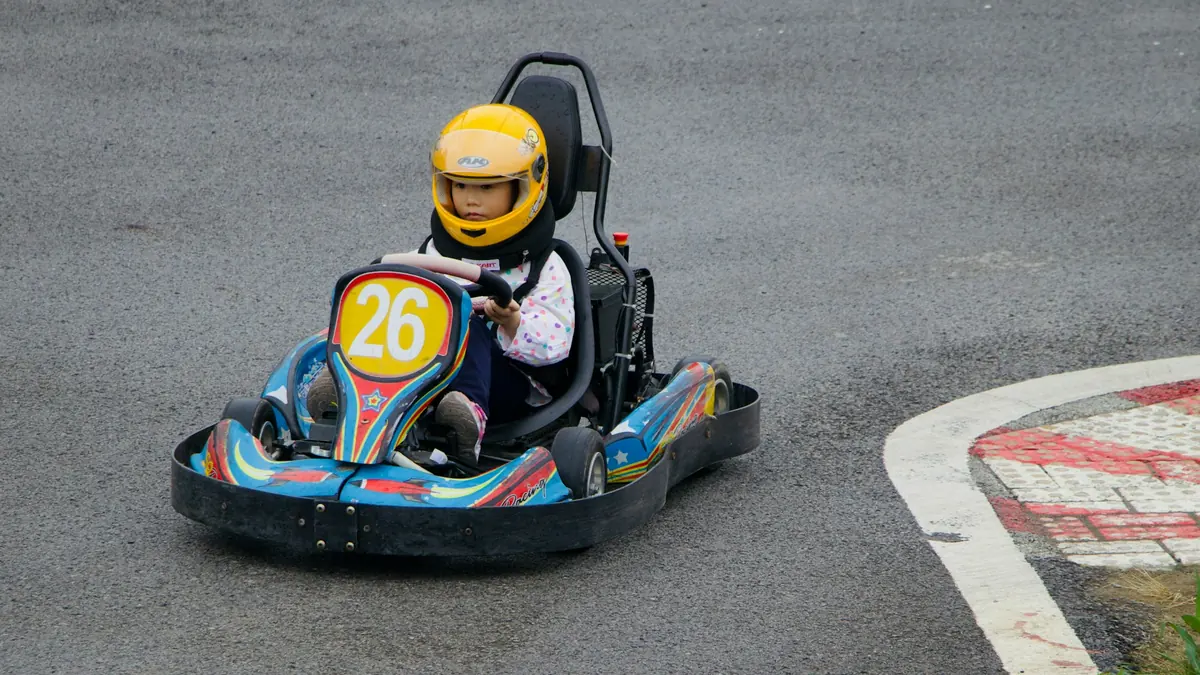
A practical guide for parents to understanding minimum karting ages, height requirements, junior karts, safety considerations and when children can begin racing.
One of the first questions parents ask when considering karting for their children is simple: At what age can kids start karting?
The answer depends on the type of karting, the facility, the equipment and the child’s physical and developmental readiness.
Some karting facilities offer introductory experiences for very young children, while others require participants to be older or meet specific height requirements. Organized kart racing has its own age categories and eligibility rules.
For parents, this can be confusing. A child might be old enough to participate at one facility but not at another.
The important thing to understand is that there is no universal minimum age for all forms of karting.
This guide explains the typical starting options for different age groups, how to evaluate whether your child is ready, what safety precautions to consider and how to find an appropriate first karting experience.
1. What Is the Minimum Age for Go-Karting?
The minimum age for go-karting varies according to the facility and the type of kart.
Some introductory programs may accept children around four or five years old, while many standard rental karting experiences require older participants.
Competitive karting organizations also establish minimum ages for their different junior categories.
These age ranges are general examples, not universal rules.
<box></box>
| Child’s age | Karting possibilities |
|---|---|
| Under 4 | Most conventional karting activities are not suitable; specialized experiences may exist |
| 4–5 | Selected introductory or supervised junior programs, where available |
| 6–7 | Some junior rental programs and introductory racing pathways |
| 8–12 | A wider range of junior rental karts, training and eligible racing categories |
| 13–15 | Additional rental, training and competition opportunities |
| 16–17 | More options, potentially including higher-performance rental karts, subject to facility rules |
These examples should never replace the published requirements of an individual operator or racing organization.
The best starting age is the age at which your child can safely operate an appropriately sized kart, follow instructions and enjoy the experience.
Why do age limits vary?
Different facilities use different vehicles, circuits and operating procedures.
A low-powered junior kart designed for a small child is very different from a larger, faster rental kart intended for adults.
Age requirements may also reflect insurance conditions, staffing, track configuration and equipment availability.
Before visiting any centre, confirm both the minimum age and the minimum height.
2. Can Toddlers or Preschool Children Try Karting?
Parents sometimes want to introduce children to karting at a very young age.
While a small number of specialized experiences may cater to preschool-aged children, conventional rental karting is generally not designed for toddlers.
Young children may have difficulty reaching the controls, maintaining attention or understanding track instructions.
What about children under four?
For children under four, it is usually more appropriate to wait before considering conventional karting.
Parents can introduce the sport through age-appropriate activities such as watching races, visiting a karting facility as spectators or learning basic concepts about vehicles.
What about four- and five-year-olds?
Some specialized junior programs may accept children in this age group.
These experiences may use smaller karts, limited performance, dedicated sessions or additional supervision.
However, availability is limited and requirements differ considerably.
Parents should never assume that a child is eligible simply because another facility advertises karting for young children.
How to evaluate a preschool karting program
Ask the operator:
- Is the activity specifically designed for this age group?
- Can the child comfortably reach all controls?
- What protective equipment is provided?
- How are speed and other performance characteristics managed?
- Are young children separated from older drivers?
- How are children supervised?
- What happens if a child becomes frightened or uncomfortable?
If a child cannot operate the kart properly or follow the necessary instructions, the activity should be postponed.
3. Karting for Children Ages 5–7
Between approximately five and seven years old, some children may begin accessing junior karting programs.
However, not every facility accepts children in this age group.
Junior rental karts
Some centres provide smaller karts with controls and performance characteristics suited to younger drivers.
These karts may have adjustable seats or pedals, although the available features depend on the model.
The child must be able to operate the controls correctly.
Introductory karting programs
A structured introduction can help children learn:
- How to use the accelerator and brake.
- How to steer smoothly.
- How to follow a basic driving line.
- How to recognize instructions and signals.
- How to remain aware of other participants.
- How to enter and exit the track safely.
At this stage, the objective should be familiarity and enjoyment rather than speed.
What parents should expect
Some children feel comfortable immediately, while others need several sessions to develop confidence.
Parents should avoid comparing children based on lap times or how quickly they learn.
A child who enjoys a short, controlled session is making meaningful progress.
4. Karting for Children Ages 8–12
Children between eight and twelve often have access to a wider range of junior karting activities.
Depending on the region and facility, these may include rental sessions, lessons, leagues and organized racing programs.
Junior rental karting
Rental karting is an excellent way to discover whether a child enjoys the sport.
The facility provides and maintains the karts, allowing families to try the activity without purchasing equipment.
Developing driving skills
Children who practice regularly can begin learning more advanced fundamentals:
- Looking ahead through corners.
- Braking before turning.
- Using smooth steering inputs.
- Accelerating progressively.
- Following consistent racing lines.
- Understanding track etiquette.
The focus should remain on safe, controlled driving.
Exploring karting lessons
Some facilities and clubs offer instruction for junior drivers.
An instructor experienced with children can help identify areas for improvement and introduce more structured practice.
Considering competition
Children in this age range may be eligible for certain junior racing categories, depending on the sanctioning organization and its current rules.
Parents should verify the specific age limits, equipment requirements and licence conditions before making plans.
5. Karting for Teenagers
Teenagers generally have more opportunities to participate in karting, although age and height restrictions still apply.
Recreational rental karting
Depending on the facility, teenagers may qualify for larger or more powerful rental karts.
Some establishments may still require parental consent or impose separate age restrictions.
Rental karting leagues
Certain facilities organize leagues or competitions using rental karts.
These events can help teenagers develop consistency, awareness and racecraft without purchasing their own equipment.
Competitive kart racing
Teenagers may qualify for different junior or senior racing categories depending on the organization’s rules.
The transition between categories is not necessarily based on age alone. Some organizations also specify eligibility dates, licences and technical requirements.
Starting as a teenager is not too late
Although some competitive drivers begin at a young age, teenagers can still discover karting and develop strong driving skills.
There is no requirement to pursue professional motorsport to enjoy organized racing.
The best approach is to choose a level of participation that matches the teenager’s interests, experience and available resources.
6. Minimum Height vs. Minimum Age: Which Matters More?
Parents often focus on age, but height and physical fit are equally important.
A child may meet the minimum age requirement yet still be too small to operate a particular kart safely.
Conversely, being tall enough does not automatically make a younger child eligible.
Reaching the pedals
The driver must be able to operate the accelerator and brake comfortably and effectively.
If a child cannot fully control the brake, the kart is not appropriate.
Steering control
The child must be able to reach and turn the steering wheel without excessive stretching or an uncomfortable posture.
Seat fit
A properly sized seating position helps the child maintain control.
Some karts offer adjustable components, but adjustments should be made only according to the operator’s instructions.
Understanding the rules
Even when the kart fits physically, the child must be able to follow the safety briefing and respond appropriately to instructions.
What parents should do
Before booking, provide the child’s actual age and height to the facility.
Ask whether an appropriate kart is available and whether additional fit requirements apply.
Do not attempt to bypass minimum age or height restrictions.
7. Indoor and Outdoor Karting Age Requirements
Indoor and outdoor karting facilities may have different eligibility requirements.
However, neither type automatically accepts younger children.
Indoor karting for children
Some indoor facilities operate junior programs using karts designed for younger drivers.
They may offer dedicated junior sessions, controlled performance settings or separate operating procedures.
Other indoor centres use only adult-sized karts and may require participants to be considerably older.
Outdoor karting for children
Outdoor facilities may offer junior rental karts, introductory lessons or access to club programs.
Some outdoor tracks also host competitive karting events.
However, a track that hosts junior racing does not necessarily offer rental karting for young children.
Which is better?
Choose based on the specific program rather than the location of the circuit.
A well-supervised junior program with properly sized equipment is more important than whether the track is indoors or outdoors.
For a detailed explanation of rental facilities, session formats and how to prepare for your first visit, read our Rental Karting guide.
8. Electric vs. Gasoline Junior Karts
Junior karting programs may use electric or gasoline-powered vehicles.
Both can be appropriate when the equipment is designed for the participants and operated under suitable procedures.
Electric junior karts
Electric karts may allow facilities to manage power electronically.
They also produce no local exhaust emissions and generally operate more quietly than gasoline-powered karts.
However, electric propulsion does not automatically make a kart safer.
The kart’s performance, physical dimensions and operating environment remain important.
Gasoline-powered junior karts
Gasoline-powered junior karts may use small combustion engines.
They can provide an introduction to the mechanical characteristics of traditional karting.
Their suitability depends on the vehicle, its configuration and the driver’s abilities.
What should parents prioritize?
Rather than choosing based only on motor type, evaluate:
- Kart dimensions and fit.
- Power and performance.
- Braking and steering controls.
- Maintenance.
- Protective equipment.
- Supervision.
- Track procedures.
For more information about the different kart technologies, explore our guide to the different types of go-karts.
9. At What Age Can Children Start Competitive Kart Racing?
Competitive karting has different requirements from recreational rental karting.
Racing organizations establish categories based on factors such as age, engine type, chassis specifications and technical regulations.
Junior racing categories
Some competitive karting pathways begin with classes intended for young children.
Other categories serve older children, teenagers and adults.
Names and age limits differ by country, championship and governing organization.
Why parents must verify the current rules
Racing eligibility can depend on:
- The child’s date of birth.
- The competition season.
- The category’s published age range.
- Licence requirements.
- Technical specifications.
- Event-specific regulations.
These rules can change from one season to another.
Parents should always consult the current regulations of the organization responsible for the events they want to enter.
Should a child start racing as soon as they are eligible?
Not necessarily.
Being old enough to compete does not mean a child is emotionally or physically ready for organized racing.
Competitive karting can involve close driving, demanding schedules, mechanical preparation and pressure from results.
A child should genuinely want to participate and be able to handle the responsibilities associated with the activity.
A gradual pathway toward competition
For many families, a practical progression is:
- Try an appropriate introductory karting experience.
- Participate in additional rental sessions.
- Develop basic control and confidence.
- Explore junior coaching or training.
- Visit a karting race as spectators.
- Learn about local clubs and racing categories.
- Consider competition when the child and family are ready.
For details about licences, racing classes, clubs and your first event, read our guide to starting kart racing in Québec.
10. How to Tell Whether Your Child Is Ready for Karting
Age is only one part of the decision.
Parents should also consider whether the child is physically comfortable, able to understand instructions and interested in participating.
Physical readiness
The child should be able to:
- Sit comfortably in the kart.
- Reach and operate the pedals.
- Control the steering wheel.
- Maintain an appropriate driving position.
- Wear the required protective equipment correctly.
Understanding instructions
The child should be able to understand the basic rules and follow directions from staff.
This includes knowing when to stop, slow down or ask for assistance.
Emotional readiness
A karting facility can be noisy and unfamiliar.
Some children enjoy the environment immediately. Others may feel overwhelmed.
A child should be willing to participate rather than feeling pressured.
Attention and concentration
Driving requires sustained attention to the track, the kart and other participants.
Parents should consider whether their child can remain focused for the duration of the planned session.
Interest and motivation
The child’s own enthusiasm matters.
If they enjoy learning about karts and want to try driving, an appropriate introductory experience may be worthwhile.
If they are hesitant, it may be better to begin with a visit as spectators.
A positive first experience is more important than starting at the youngest possible age.
11. Safety Equipment for Young Kart Drivers
Appropriate protective equipment is an essential part of junior karting.
Requirements vary between rental facilities and competitive organizations.
Helmets
A helmet should fit correctly and meet the requirements of the facility or racing organization.
Many rental centres provide helmets.
Parents should not assume that helmets intended for cycling, skiing or other activities are automatically suitable for karting.
Clothing
For rental karting, the facility may require comfortable clothing and secure, closed-toe shoes.
Some centres provide additional protective clothing.
Gloves
Gloves may be required or recommended depending on the activity.
They can help provide grip and protect the hands.
Racing suits and protective equipment
Competitive karting typically has more specific equipment requirements.
Depending on the category and regulations, these may include:
- Approved helmets.
- Karting suits.
- Gloves.
- Karting shoes.
- Rib and chest protection.
- Other mandatory protective equipment.
The exact certifications and requirements should be verified before purchasing anything.
Comfort and fatigue
Children may become tired from steering effort, vibration, heat and concentration.
Parents should take complaints of discomfort seriously.
If a child experiences pain, dizziness or difficulty controlling the kart, the session should be stopped and staff informed.
For a detailed overview, consult our essential karting safety equipment guide.
12. Choosing the Right First Karting Facility for Your Child
The best first facility is not necessarily the largest or fastest track.
It is one that offers an appropriate experience for your child’s age, abilities and comfort level.
Questions to ask before booking
Contact the operator and ask:
- What is the minimum age?
- What is the minimum height?
- Do you have karts designed for children?
- Are junior sessions separate from adult sessions?
- What protective equipment is provided?
- How are first-time drivers instructed?
- How are children supervised?
- Can parents observe the session?
- How long does a session last?
- What happens if a child becomes uncomfortable?
- Is advance booking required?
- Are there beginner lessons or junior programs?
Consider visiting before driving
If possible, visit the facility as spectators.
Let your child observe the karts, listen to the environment and ask questions.
This can help them feel more comfortable before participating.
Avoid rushing into equipment purchases
For most families, an introductory rental session is a more practical starting point than buying a racing kart.
It allows parents and children to discover whether the activity is enjoyable before committing significant resources.
Finding junior karting opportunities
DNA Karting is developing a directory of karting facilities, clubs and service providers.
As the directory expands, it will help families discover tracks and programs suited to their needs.
Until then, always verify the current age requirements, available karts and operating conditions directly with the facility.
For a broader discussion of introducing children to karting, visit our Karting for Kids & Parents guide.
13. Frequently Asked Questions About Kids’ Karting Ages
Can a 4-year-old go karting?
Some specialized introductory programs may accept four-year-olds, but many facilities do not.
Confirm the program’s age requirements, equipment and supervision before booking.
Can a 5-year-old drive a go-kart?
Some junior karting programs may accept five-year-olds.
Eligibility depends on the specific facility and whether the child meets all physical and participation requirements.
Can a 6-year-old go karting?
Some facilities offer junior karting for six-year-olds.
Others have higher minimum age or height requirements.
Can an 8-year-old go karting?
Many junior karting programs cater to children in this age range, but availability and eligibility vary.
Check with the operator before visiting.
Can a 10-year-old race go-karts?
A ten-year-old may be eligible for certain competitive karting categories, depending on the organization and its current regulations.
Is there a minimum height for go-karting?
Many rental facilities establish minimum height requirements.
These limits vary according to the kart and operating conditions.
Do kids need a driver’s licence to go karting?
A road driver’s licence is generally not required for junior rental karting, although each facility has its own rules.
Competitive karting may require a separate motorsport licence.
Are electric go-karts safer for children?
Not automatically.
Safety depends on the kart’s design, performance, fit, maintenance, supervision and operating procedures.
Should children start with rental karting or racing?
For most families unfamiliar with the sport, rental karting offers a practical introduction without the cost and responsibilities of owning a kart.
Is my child too old to start karting?
Children and teenagers can begin karting at many different ages.
There is no requirement to start extremely young to enjoy recreational karting or explore amateur competition.
Final Thoughts: Choosing the Right Age to Start Karting
There is no single minimum age that applies to every karting facility or racing program.
Some children may have access to specialized introductory experiences at a young age, while others will need to wait until they meet the requirements of local rental centres.
The most important factors are physical fit, understanding of instructions, appropriate supervision and genuine interest.
Parents should avoid rushing the process.
A well-chosen first session can help a child develop confidence, discover a new interest and enjoy an exciting family activity.
If your child becomes enthusiastic about karting, there will be opportunities to explore additional sessions, coaching, junior programs and possibly competitive racing.
Continue Exploring Karting with DNA Karting
For a complete overview of children’s karting, including safety, costs, equipment and progression, read our Karting for Kids & Parents guide.
If your family is new to the sport, our complete beginner’s guide to karting explains the fundamentals of rental and competitive karting.
DNA Karting is building practical resources to help parents, beginners and racing enthusiasts discover the sport and make informed decisions.
The right time to start karting is when your child is ready, the equipment is appropriate and the experience can be enjoyable and well supervised.
Every karting journey begins with a first experience.
