


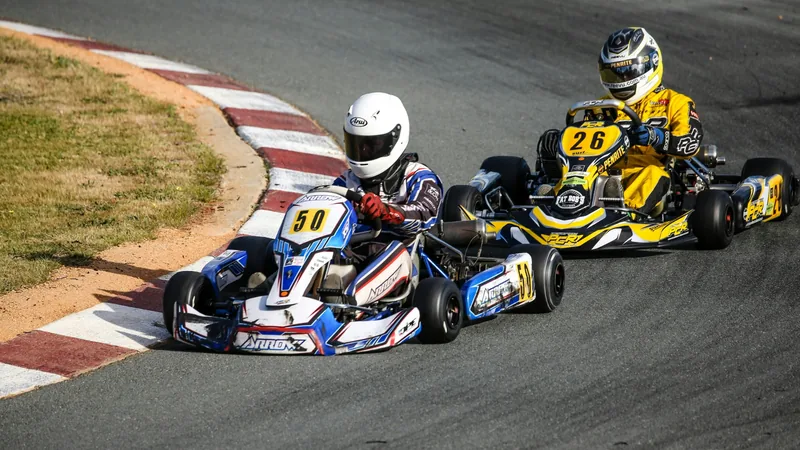
Rental karting is an exciting way to experience motorsport, but enjoying the track involves more than controlling your own kart. Every participant shares the circuit with other drivers, often with different experience levels, confidence and driving abilities.
One driver may be completing a first-ever session. Another may have visited the same circuit many times. Both have a responsibility to drive predictably, respect the instructions provided and avoid creating unnecessary risks for others.
Good karting etiquette is not about being excessively cautious or avoiding every competitive moment. It is about understanding that the track is a shared environment where individual decisions affect everyone.
This DNA Karting guide explains the essential principles of responsible rental karting: listening to instructions, leaving adequate space, avoiding contact, respecting other drivers, responding to incidents and maintaining appropriate behaviour throughout a session.
These principles apply broadly to recreational karting, but every facility has its own operating rules. The briefing and instructions given by the operator always take priority.
1. Understand the Difference Between Karting Rules and Karting Etiquette
Rules and etiquette are closely related, but they are not exactly the same.
Karting rules are requirements established by the facility. They may define permitted behaviour, track access, overtaking restrictions, signals, speed controls and the consequences of ignoring instructions.
Karting etiquette refers to the habits and decisions that help participants share the circuit respectfully, even when a specific situation is not addressed by a written rule.
For example, a facility may prohibit deliberate contact between karts. That is a rule.
Choosing to leave extra room for a visibly inexperienced driver is an example of good etiquette.
Likewise, following a marshal’s instruction is mandatory under the facility’s rules. Remaining calm when another driver makes a mistake reflects responsible conduct.
The two work together. Written rules establish minimum expectations, while good etiquette helps drivers respond appropriately to situations that change from one moment to the next.
A useful principle is simple: drive in a way that other participants can reasonably anticipate, without assuming that they will always make the correct decision.
2. Treat the Safety Briefing as Part of the Driving Session
The safety briefing is not merely a formality.
It establishes how a particular facility expects drivers to behave and explains procedures that may differ from those used elsewhere.
Even experienced drivers should pay attention when visiting a new circuit.
A briefing may address permitted overtaking, track signals, restricted areas, kart operation, incident procedures and how staff communicate with participants.
The important point is not to memorize a universal set of rental-karting rules. It is to understand the rules that apply to the session you are about to drive.
Never assume that rules are identical everywhere
One venue may allow passing throughout most of the circuit, while another may restrict it to designated sections.
Some facilities use traditional flags. Others rely partly on lights, electronic speed controls or direct instructions from marshals.
The correct response depends on the system explained by the operator.
If an instruction is unclear, ask before driving rather than improvising on the track.
For readers preparing for their first visit, our guide to what to expect at your first rental karting session explains the overall experience. This article concentrates on how to behave once the activity is underway.
3. Follow Marshals and Track Instructions Immediately
Track marshals and other authorized staff supervise the activity, monitor incidents and communicate instructions to drivers.
Their role is particularly important because a participant may not be able to see everything happening elsewhere on the circuit.
A marshal may instruct drivers to slow down, maintain their positions, enter the pit lane, stop in a designated location or follow another procedure.
Respond promptly and predictably.
Why immediate compliance matters
Suppose a kart becomes immobilized around a corner.
Drivers approaching the area may not see the problem until they are relatively close.
A marshal’s signal gives them an opportunity to adjust before reaching the incident.
Ignoring that signal can expose the stopped driver, staff and other participants to unnecessary danger.
Do not debate instructions while driving
If you believe an instruction was incorrect or unfair, follow it first.
Discuss the situation with the facility afterward, in an appropriate area.
Trying to argue, gesture aggressively or continue driving in defiance of a marshal only complicates the situation.
Understand the signals used at your facility
Rental facilities may use flags, lights, signs or other communication systems.
Their meanings and required responses should be explained during the briefing.
Our guide to karting flags and race rules provides additional background on traditional karting signals. However, competition flag procedures should not be assumed to apply identically to every rental session.
4. Remember That Rental Karting Is Not a Contact Activity
One of the most important principles of rental karting etiquette is to avoid deliberate contact.
A kart is not a bumper car.
Intentionally hitting another vehicle, pushing it through a corner or using contact to gain a position creates risks for drivers and can damage equipment.
Even a relatively low-speed impact may have consequences because drivers are seated close to the ground and exposed to forces that are different from those experienced in ordinary road vehicles.
Intentional contact versus accidental contact
Accidental contact can occur when drivers misjudge speed, distance or the actions of another participant.
That does not make contact acceptable or harmless.
However, there is a meaningful difference between an isolated mistake and deliberately using a kart to strike another vehicle.
Responsible drivers work to prevent both.
Why minor bumps should not be normalized
Some participants assume that light contact is part of the entertainment.
This attitude can lead to progressively more aggressive behaviour.
A small bump may unsettle another kart, particularly when the driver is braking or turning.
It can also surprise a beginner who has not yet developed confidence in controlling the vehicle.
The better approach is to leave sufficient space and avoid treating contact as a normal method of driving.
What to do after contact
If contact occurs, remain attentive to the track and follow staff instructions.
Do not stop unpredictably to confront the other driver.
Do not retaliate with another collision.
If the kart behaves abnormally or you suspect damage, notify staff using the procedure established by the facility.
Any disagreement can be addressed after the session.
5. Leave Enough Space Around Other Karts
Maintaining appropriate separation is one of the most useful habits in rental karting.
The amount of space required depends on speed, visibility, braking conditions, the circuit layout and the behaviour of surrounding drivers.
There is no single distance that is correct in every situation.
Avoid following too closely
When driving directly behind another kart, remember that the driver ahead may brake earlier than you expect.
This is particularly common when participants have different experience levels.
Following too closely reduces the time available to react and increases the possibility of contact.
If you are consistently closing the gap under braking, reconsider your following distance rather than expecting the other driver to change their technique.
Leave room beside another kart
When two vehicles are close together, both drivers need enough room to maintain control.
Do not deliberately squeeze another kart toward a barrier or the edge of the circuit.
Avoid sudden movements that could surprise a driver travelling alongside you.
Consider the other driver’s experience
A beginner may turn earlier, brake more cautiously or follow an unfamiliar path through a corner.
Experienced drivers should anticipate that possibility.
A slower driver is not necessarily behaving improperly.
Sharing the circuit responsibly means allowing for reasonable differences in ability.
6. Overtake Only When It Is Permitted and Appropriate
Overtaking can be part of a rental karting session, but it should never be treated as an entitlement.
The facility determines whether passing is permitted and may specify where or how it must occur.
Check the rules before attempting a pass
Some venues restrict overtaking in particular areas or during certain types of sessions.
Others may use signals to manage faster and slower drivers.
Do not assume that a manoeuvre permitted during organized competition is appropriate in recreational rental karting.
Avoid forcing a pass
A pass should not depend on the other driver suddenly changing direction or making an emergency correction.
If there is insufficient space, wait.
Trying to force a kart into a narrowing gap can create contact even when the driver attempting the pass believes the opportunity is available.
Do not deliberately block another driver
Good etiquette also applies when someone is approaching from behind.
Repeatedly changing direction solely to prevent another kart from passing can create unpredictable situations.
Maintain a stable, understandable path and follow the facility’s passing instructions.
Do not suddenly move aside without checking the situation.
A faster driver does not have unlimited priority
Being quicker does not give someone the right to make contact, ignore restrictions or pressure another participant into unsafe manoeuvres.
Likewise, a slower driver should not deliberately obstruct others.
The shared responsibility is to keep interactions predictable and respectful.
Detailed passing strategies and competitive racecraft belong to a different kind of karting activity. Everyday rental etiquette is primarily about cooperation and avoiding unnecessary risk.
7. Drive Predictably Rather Than Aggressively
Predictability is one of the most valuable qualities a driver can bring to a shared circuit.
Other participants make decisions based partly on what they expect nearby karts to do.
Sudden, unexplained movements can make those decisions more difficult.
Avoid unnecessary weaving
Moving repeatedly from side to side can surprise approaching drivers.
Unless the circuit layout or a specific instruction requires a change in direction, maintain a deliberate and understandable path.
Avoid deliberate spinning or drifting
Some facilities explicitly prohibit intentional spins, drifting and other manoeuvres that interfere with normal circulation.
Even where a kart is capable of sliding, deliberately provoking a loss of control during a shared rental session can create hazards.
Follow the operator’s rules rather than attempting to imitate motorsport demonstrations.
Do not use the track to settle disagreements
If another participant passes you, slows you down or makes a mistake, remain focused on driving.
Aggressive gestures, deliberate obstruction and retaliatory manoeuvres are inappropriate.
The goal is to complete the session responsibly, not to punish another driver.
Maintain awareness beyond the kart immediately ahead
Look far enough ahead to recognize slowing traffic, developing incidents and staff signals.
Also remain aware of nearby vehicles.
This awareness supports both respectful conduct and better driving.
For a broader discussion of vision and vehicle control, see our karting driving techniques guide.
8. Know How to Respond When Something Goes Wrong
A kart may spin, stop unexpectedly or become involved in an incident.
A driver may also notice an obstacle or another participant in difficulty.
The appropriate response depends on the facility’s instructions and the immediate circumstances.
If your kart spins
Do not immediately accelerate or attempt to rejoin the normal driving path without assessing the situation.
Follow the operator’s procedure.
At many rental facilities, drivers are expected to remain seated and wait for staff instructions rather than attempting to move the kart manually.
Do not assume that you should exit the kart or restart movement on your own.
If your kart becomes immobilized
Avoid sudden attempts to move the vehicle into active traffic.
Keep your hands, feet and body within the kart unless staff direct otherwise or an immediate emergency requires a different response.
Follow the briefing’s instructions for attracting staff attention.
If the kart cannot be driven normally, allow authorized personnel to manage the situation.
If you encounter an incident ahead
Reduce speed and respond to the applicable signals and instructions.
Do not attempt to squeeze through a restricted area or take advantage of another driver’s difficulty.
Do not stop merely to observe an incident unless instructed or required by an immediate hazard.
If your kart develops a mechanical problem
Unexpected steering behaviour, braking problems, unusual noises or other mechanical symptoms should be reported.
Follow the facility’s procedure for slowing down and returning to staff when possible.
Do not continue driving aggressively to determine whether the problem will disappear.
If there is a medical emergency
Follow staff directions and the venue’s emergency procedures.
Do not enter an active track area to assist unless directed by authorized personnel or required by an immediate emergency.
The exact procedure may vary according to the circumstances.
9. Respect Pit Lanes and Controlled Areas
The pit lane and other controlled areas connect active driving with the parts of the facility used by staff and participants.
These areas often involve people on foot, stationary vehicles and restricted movement.
Enter and leave only as instructed
Use the designated route and follow the facility’s directions.
Do not cut across the track to reach an exit or make a last-second change of direction toward the pit lane.
Reduce speed appropriately
A pit lane is not another racing section.
Observe the speed requirements and directions provided by staff.
The exact limit or procedure may differ between facilities.
Wait for permission before moving
Do not assume that you may leave a staging area, restart a kart or enter the circuit whenever you wish.
Follow the staff member responsible for releasing vehicles.
Remain in the kart when instructed
Some facilities require drivers to remain seated until staff authorize them to get out.
This helps control movement around vehicles and other participants.
Follow the local procedure rather than copying what you have seen at another venue.
10. Respect Drivers With Different Experience Levels
Rental karting often brings together people who approach the activity for different reasons.
Some want to experience driving a kart for the first time.
Others enjoy improving their lap times or sharing a recreational activity with friends.
These objectives can coexist when participants respect one another.
For experienced drivers
Do not expect every participant to use the same braking points or corner speeds.
Allow for hesitation and occasional mistakes.
Avoid pressuring inexperienced drivers by following extremely closely or attempting risky passes.
For beginners
Drive within your comfort level while remaining attentive to instructions and surrounding traffic.
You do not need to match the pace of a faster driver.
However, you should avoid unnecessary obstruction and follow any procedures intended to manage speed differences.
For friends and groups
Do not turn a recreational session into an improvised contact competition.
Encouraging someone to bump another kart, deliberately block a friend or ignore staff instructions undermines the experience for everyone.
Good etiquette applies even when all participants know one another.
11. Maintain Appropriate Behaviour Throughout the Session
Respectful driving includes how participants interact with staff and other customers.
Avoid aggressive or abusive conduct
Shouting at another driver, making threatening gestures or arguing with marshals is inappropriate.
If an incident needs to be discussed, wait until the activity has ended and speak with staff calmly.
Do not drive while impaired
Alcohol, recreational drugs and substances or medications that impair attention, judgment or coordination are incompatible with responsible kart operation.
Facilities may impose specific participation restrictions.
If you are unsure whether you can operate a kart safely, do not drive and seek appropriate advice.
Keep your attention on driving
Do not attempt to use a phone, take photographs or handle distracting objects while operating a kart.
Follow the facility’s restrictions concerning personal belongings and recording devices.
Accept staff intervention
A facility may warn a participant, reduce a kart’s speed, interrupt a session or remove a driver for unsafe behaviour.
The available measures and consequences vary by operator.
If staff intervene, comply with their directions and discuss any concerns afterward.
12. Common Etiquette Mistakes and Better Alternatives
Several behaviours can cause problems even when a participant does not intend to be disrespectful.
Mistake: Treating a slower kart as an obstacle
Why it matters: The driver ahead may be inexperienced or following instructions.
Better approach: Maintain space, remain patient and pass only when permitted and appropriate.
Mistake: Assuming light contact is harmless
Why it matters: Even a small impact can unsettle another vehicle.
Better approach: Avoid deliberate contact and maintain a suitable following distance.
Mistake: Ignoring a signal because the track looks clear
Why it matters: Staff may be responding to a hazard outside your field of vision.
Better approach: Follow instructions immediately.
Mistake: Stopping to confront another driver
Why it matters: An unexpected stop can create a new hazard.
Better approach: Continue according to the venue’s procedure and raise the concern with staff afterward.
Mistake: Copying racing behaviour from videos
Why it matters: Competition techniques and rules may not be appropriate for public rental sessions.
Better approach: Follow the facility’s specific conduct requirements.
Mistake: Becoming frustrated after a mistake
Why it matters: Frustration can lead to rushed decisions and aggressive driving.
Better approach: Regain composure, concentrate on the next section of track and remain within your abilities.
13. A Practical Decision Framework for Shared-Track Situations
When uncertain about how to behave, consider four questions.
1. Is the action permitted?
The operator’s rules and current instructions come first.
If a manoeuvre is prohibited, there is no reason to attempt it.
2. Is there enough space?
Consider the position and likely movement of nearby karts.
Do not depend on another driver making a sudden correction.
3. Will my action be predictable?
A controlled, understandable movement is generally easier for others to anticipate than an abrupt change.
4. What happens if the other driver makes a mistake?
Leave a reasonable margin for differences in experience, visibility and reaction.
If the situation remains uncertain, choosing patience over aggression is usually the more responsible option.
This framework is not a substitute for the facility’s rules, but it can help guide everyday decisions.
14. Frequently Asked Questions About Rental Karting Etiquette
Is bumping allowed in rental karting?
Deliberate contact is generally prohibited by rental karting operators. Follow the specific facility’s rules and do not treat the karts as bumper cars.
Can you overtake slower drivers?
Overtaking depends on the facility and session format. Pass only where and how the operator permits, with adequate space and without forcing another driver to react suddenly.
What should you do if someone drives aggressively?
Avoid retaliation. Maintain control, follow track instructions and report the behaviour to staff through the appropriate procedure.
Should you get out if your kart stops?
Follow the briefing and staff instructions. Many rental facilities direct drivers to remain seated while staff manage an immobilized kart. Immediate emergencies may require a different response.
Do racing flags mean the same thing at every rental track?
Not necessarily. Some facilities use different flags, lights or electronic controls. Learn the communication system explained at your venue.
What if you accidentally hit another kart?
Do not retaliate or stop unpredictably. Follow staff instructions, report any suspected damage or injury and discuss the incident after the session.
Is it acceptable to drive slowly?
Drivers should operate within their abilities and follow the facility’s minimum expectations. Slower participants should remain predictable and comply with instructions for managing faster traffic.
Conclusion: Respect Makes Rental Karting Better for Everyone
Good rental karting etiquette is built on a few lasting principles: follow instructions, drive predictably, leave room, avoid deliberate contact and treat other participants with respect.
These habits matter because every driver contributes to the conditions experienced by everyone else.
A faster driver has a responsibility to avoid unnecessary risks. A beginner has a responsibility to remain attentive and follow instructions. All participants should respond appropriately when staff intervene or an incident occurs.
No set of general guidelines replaces the rules of a particular facility, and no driving activity can be guaranteed risk-free.
At DNA Karting, we believe that understanding responsible conduct is an essential part of enjoying karting. Respect for other drivers, the equipment and the people supervising the circuit helps create a more organized and enjoyable experience for everyone.
